

The B.S. in Engineering gives you a broad foundation across the field, without asking you to concentrate in a single discipline. You explore multiple areas of engineering, develop an understanding of how they connect and shape a direction of your own, even without declaring a formal concentration. That flexibility also lets you pursue academic interests elsewhere at Elon, from business and entrepreneurship to professional writing and rhetoric to world languages.

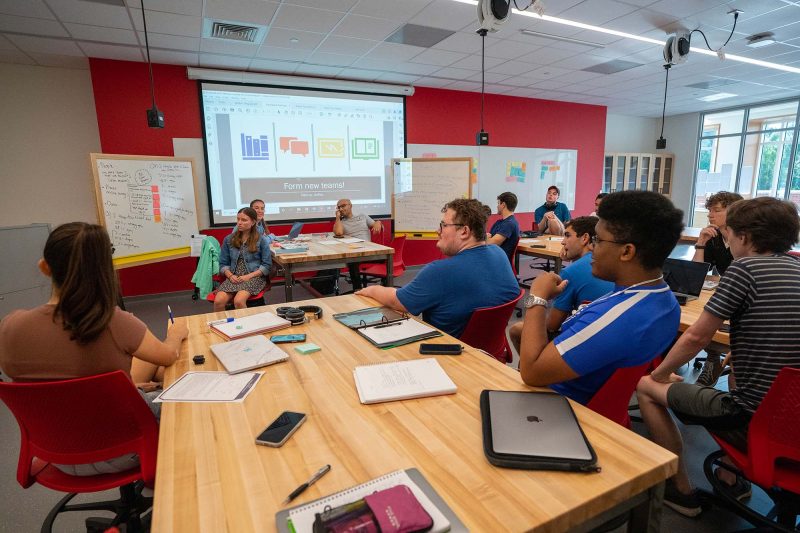
Students at work in Dr. Sirena Hargrove-Leak’s classroom in the Innovation Quad

What You'll Study

Engineering

Your coursework moves through mechanics, materials, computing and design. Each year, a hands-on design experience puts that learning into practice through prototyping, experimentation, collaborative problem-solving, service learning and research.
Major Requirements & Courses

The B.S. in Engineering is a 97 credit hour program that combines a strong foundation in mathematics and the sciences with core and advanced engineering coursework, annual design experience and opportunities to explore other areas of interest.

Math & Science — 32 semester hours

Build the mathematical and scientific foundation you’ll use throughout your engineering studies, with coursework in calculus, physics and chemistry and additional study chosen from mathematics and the sciences.

  • General Chemistry I
  • University Physics I
  • University Physics II
  • Calculus I
  • Calculus II
  • Multivariable Calculus & Analytic Geometry
  • Differential Equations

Choose at least one additional course — 4 semester hours

  • General Chemistry II
  • Introductory Cell Biology
  • Cell Biology Labratory
  • Human Anatomy Lab
  • Human Physiology
  • Human Physiology Lab
  • Linear Algebra
  • Discrete Structures
  • Statistics in Application
  • Probability Theory and Statistics
  • Introduction to Environmental Science
  • Introduction to Environmental Science Lab
  • Computational Tools for Astrophysics Research
  • Modern Physics

Engineering Foundations & Design — 33 semester hours

Develop your engineering knowledge through computing, mechanics, materials and a sequence of design experiences that begins early in the program and continues through your senior year.

  • Introduction to Engineering
  • Engineering Computing with MATLAB
  • Computer Science I
  • Engineering Graphical Communication
  • Engineering Mechanics – Statics
  • Engineering Mechanics – Dynamics
  • Engineering Design for Service
  • Structure and Properties of Materials
  • Senior Engineering Design I
  • Senior Engineering Design II
  • Senior Comprehensive Evaluation

Social Sciences & Humanities — 8 semester hours

Bring economic and ethical perspectives into your engineering education by completing one economics course and one ethics course. These courses may also count toward the Elon Core Curriculum.

  • Principles of Economics
  • Statistics for Decision Making
  • Ethical Practice
  • Environmental Ethics

Engineering Electives — 24 semester hours

Choose 24 semester hours of EGR electives:

Your typical four-year plan

The recommended sequence shows how a full four-year course of study fits together.
You'll work with your advisor to find the right path for you.

Year One — 40 semester hours

Fall Semester

  • Calculus I
  • Writing: Argument and Inquiry or Global Experience
  • University Physics I & Lab
  • Grand Challenges in Engineering I
  • Engineering Computing with MATLAB
  • Orientation

Winter Term

  • Core Curriculum

Spring Semester

  • Calculus II
  • Global Experience or Writing: Argument and Inquiry
  • University Physics II & Lab
  • Computer Science I
  • Grand Challenges in Engineering II

Year Two — 38 semester hours

Fall Semester

  • Multivariable Calculus and Analytic Geometry III
  • General Chemistry I & Lab
  • Engineering Mechanics: Statics
  • Engineering Design for Service
  • Degree Elective

Winter Term

  • Core Curriculum

Spring Semester

  • Differential Equations
  • Engineering Mechanics: Dynamics
  • Structure and Properties of Materials
  • Undergraduate Research
  • Degree Elective

Year Three — 40 semester hours

Fall Semester

  • Core Curriculum
  • Degree Elective
  • Degree Elective
  • Free Elective

Winter Term

  • Core Curriculum

Spring Semester

  • Core Curriculum
  • Degree Elective
  • Free Elective
  • Free Elective

Year Four — 40 semester hours

Fall Semester

  • Senior Engineering Design I
  • Capstone Seminar (Core Curriculum)
  • Degree Elective
  • Degree Elective
  • Free Elective

Winter Term

  • Core Curriculum

Spring Semester

  • Senior Engineering Design II
  • Degree Elective
  • Free Elective
  • Free Elective

Is this program right for you?

A place for curious problem solvers.

The B.S. in Engineering fits if you want engineering breadth and are ready to point that breadth in a direction of your own. Because you’re not tied to a single concentration, the direction you build often comes from what you add through electives, your Core Curriculum choices or a minor. That direction can lead toward graduate study, but just as often it leads toward a career shaped by your own combination of engineering fundamentals and additional preparation.

Where a B.S. in Engineering might lead

There are many combinations of courses that you can add to your degree path, and a wide range of professional opportunities. A few options are here, but talk with your advisor about a combination that fits the direction you're considering.

Systems and technology

Additional study in

  • Systems modeling
  • Programming
  • Databases
  • Controls
  • Requirements Analysis

Possible role as

  • Systems Engineer
  • Systems Analyst
  • Integration Engineer

Product and design

Additional study in

  • CAD
  • Prototyping
  • Human-Centered Design
  • Materials
  • Design Portfolio

Possible role as

  • Product Development Engineer
  • Product Engineer
  • Design Engineer

Data and analysis

Additional study in

  • Statistics
  • Python
  • Data Visualization
  • Optimization
  • Machine Learning

Possible roles as

  • Engineering Analyst
  • Simulation Analyst
  • Reliability Analyst

Your Faculty

Faculty traditionally associated with the B.S. in Engineering major.