

The B.S. in Civil Engineering prepares you to design and improve the places and systems communities depend on. You build a foundation in engineering, mathematics and science, then choose courses that take you further into structures, water systems or environmental engineering. You can also connect that technical work with study in ecology, public policy or geographic information systems, bringing more perspectives to the people and places your decisions affect.

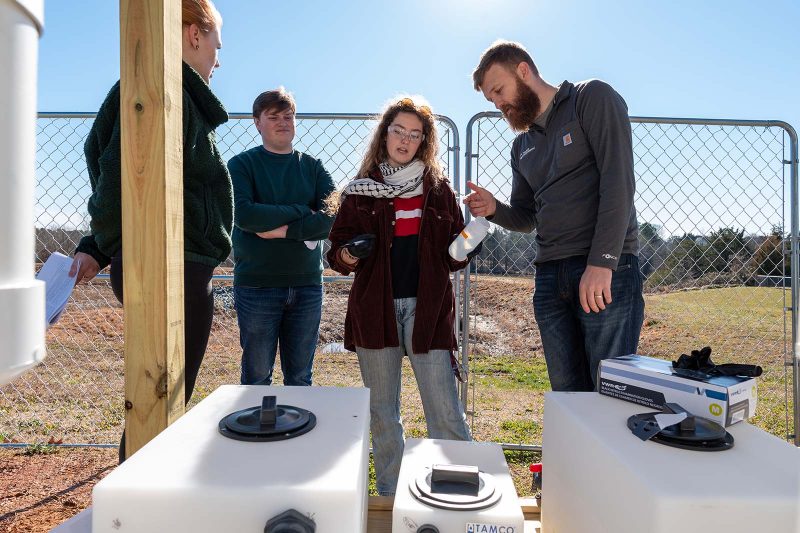
Lauren Hill ’24 testing the novel organic/inorganic composite materials with stormwater in the field

What You'll Study

Civil Engineering

You’ll study mechanics, materials and engineering design, then choose from courses such as structural analysis, soil mechanics, hydrology and water and wastewater treatment. Design courses and a senior project give you opportunities to develop and test solutions with others.
Major Requirements & Courses

The B.S. in Civil Engineering is a 99 credit hour program combining mathematics and science, engineering foundations, design work and seven engineering electives. Economics and ethics courses add perspective on the decisions civil engineers make.

Math & Science — 28 semester hours

  • General Chemistry I
  • University Physics I
  • University Physics II
  • Calculus I
  • Calculus II
  • Multivariable Calculus & Analytic Geometry
  • Differential Equations

Choose at least one additional course — 4 semester hours

  • General Chemistry II
  • Introductory Cell Biology
  • Cell Biology Laboratory
  • Urban Ecology
  • Biodiversity
  • Wetlands Ecology and Management
  • Linear Algebra

Engineering Foundations & Design — 31 semester hours

  • Introduction to Engineering
  • Engineering Graphical Communication
  • Computer Science I
  • Engineering Mechanics – Statics
  • Engineering Mechanics – Dynamics
  • Structure and Properties of Materials
  • Engineering Design for Service
  • Senior Engineering Design I
  • Senior Engineering Design II
  • Senior Comprehensive Evaluation

Social Sciences & Humanities — 8 semester hours

Choose one economics and one ethics course. These courses may count toward the Elon Core Curriculum requirements. Possible options include the following courses. For other courses in this category, seek approval from the Director of Engineering Programs.

  • Principles of Economics
  • Statistics for Decision Making
  • Ethical Practice
  • Ethics and Decision Making
  • Environmental Ethics

Engineering Electives — 28 semester hours

Choose seven of the following engineering elective courses:

  • Mechanics of Solids
  • Engineering Fluid Mechanics
  • Engineering Thermodynamics
  • Soil Mechanics
  • Hydrology
  • Structural Analysis
  • Heat and Mass Transfer
  • Water and Wastewater Treatment

Your typical four-year plan

The recommended sequence shows how a full four-year course of study fits together.
You'll work with your advisor to find the right path for you.

Year One — 38 semester hours

Fall Semester

  • Calculus I
  • Writing: Argument and Inquiry
  • University Physics I (includes laboratory)
  • Introduction to Engineering
  • First-Year Advising Seminar

Winter Term

  • Core Curriculum — Expression: literature

Spring Semester

  • Calculus II
  • The Global Experience
  • University Physics II (includes laboratory)
  • Computer Science I
  • Engineering Graphical Communication

Year Two — 34 semester hours

Fall Semester

  • Multivariable Calculus and Analytic Geometry
  • General Chemistry I (plus required zero-credit recitation)
  • Engineering Mechanics – Statics
  • Engineering Design for Service

Winter Term

  • Core Curriculum — Civilization: history or art history

Spring Semester

  • Differential Equations
  • Engineering Mechanics – Dynamics
  • Mechanics of Solids
  • World Language — Elementary I (if needed by placement)

Year Three — 36 semester hours

Fall Semester

  • Introduction to Environmental Engineering (includes laboratory)
  • Engineering Fluid Mechanics
  • Principles of Economics
  • World Language — Elementary II

Winter Term

  • Core Curriculum — Society: a discipline other than economics

Spring Semester

  • Structure and Properties of Materials
  • Soil Mechanics (includes laboratory)
  • Hydrology (includes laboratory)
  • Core Curriculum — Advanced Studies outside the major

Year Four — 36 semester hours

Fall Semester

  • Structural Analysis
  • Senior Engineering Design I
  • Core Curriculum — Integrative Core Capstone Seminar
  • Free Elective

Winter Term

  • Core Curriculum — Advanced Studies outside the major

Spring Semester

  • Water and Wastewater Treatment
  • Senior Engineering Design II
  • Linear Algebra (additional math/science requirement)
  • Approved Ethics Course (Expression credit if eligible)
  • Senior Comprehensive Evaluation
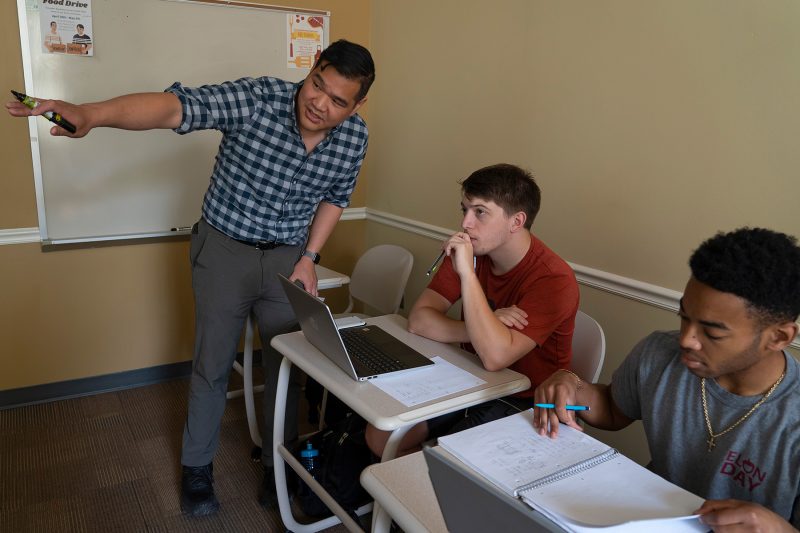
Jonathan Su, assistant professor of engineering, teaching Engineering students at Elon

Is this program right for you?

Design for the places we share.

The B.S. in Civil Engineering fits if you want to understand how structures stand, how water moves and how the built environment affects the people who use it. Your electives let you develop a direction in structures, water systems or environmental work. Study elsewhere at Elon can help you consider the ecological, social and policy questions that come with designing something a community will depend on.

Where a B.S. in Engineering might lead

There are many combinations of courses that you can add to your degree path, and a wide range of professional opportunities. A few options are here, but talk with your advisor about a combination that fits the direction you're considering.

Structures and construction

Additional study in

  • Structural Analysis
  • Soil Mechanics
  • The Art of Sustainable Architecture
  • Geographic Information Systems

Possible role as

  • Structural Engineer
  • Geotechnical Engineer
  • Civil Design Engineer

Water and the environment

Additional study in

  • Hydrology
  • Water and Wastewater Treatment
  • Wetlands Ecology and Management
  • Public Health

Possible role as

  • Water Resources Engineer
  • Environmental Engineer
  • Water Quality Analyst

Community infrastructure

Additional study in

  • Geographic Information Systems
  • Urban Ecology
  • Public Policy
  • Environmental and Sustainability Studies

Possible roles as

  • Municipal Engineer
  • Transportation Planner
  • Infrastructure Analyst

Your Faculty

Faculty traditionally associated with the B.S. in Engineering major.