

The B.S. in Mechanical Engineering gives you a foundation for designing and improving machines and systems. You study how forces, materials, motion and energy shape what those systems can do, then put that knowledge to work through design. Mechanical engineering can take you toward products, energy systems or robotics. At Elon, you can connect those interests with study in computing, sustainability or entrepreneurship.

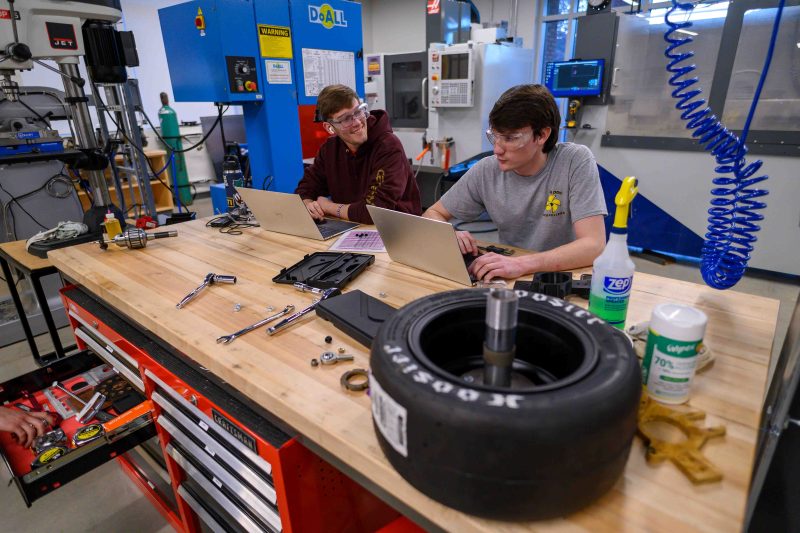
Two students work in a lab

What You’ll Study

Mechanical Engineering

Your coursework moves from mechanics and materials into fluid flow, thermodynamics, machine design and controls. Design experiences culminate in a two course senior project, where you work with peers and faculty to develop and test a solution.
Major Requirements & Courses

The B.S. in Mechanical Engineering is listed as a 97 credit hour program. It combines mathematics and science with engineering foundations, design and six advanced mechanical engineering courses. A breadth choice lets you study manufacturing, robotics or circuits.

Math & Science — 32 semester hours

  • General Chemistry I
  • University Physics I
  • University Physics II
  • Calculus I
  • Linear Algebra
  • Calculus II
  • Multivariable Calculus and Analytic Geometry
  • Differential Equations

Engineering Foundations & Design — 25 semester hours

  • Introduction to Engineering
  • Engineering Graphical Communication
  • Computer Science I
  • Engineering Mechanics – Statics
  • Engineering Mechanics – Dynamics
  • Engineering Design for Service
  • Structure and Properties of Materials
  • Senior Engineering Design I
  • Senior Engineering Design II
  • Senior Comprehensive Evaluation

Social Sciences & Humanities — 8 semester hours

Choose one economics and one ethics course. These courses may count toward the Elon Core Curriculum requirements. Possible options include the following courses. For other courses in this category seek approval of the Chair of the Engineering Department.

  • Principles of Economics
  • Statistics for Decision Making
  • Ethical Practice
  • Ethics and Decision Making
  • Environmental Ethics

Mechanical Depth required courses — 24 semester hours

  • Mechanics of Solids
  • Engineering Fluid Mechanics
  • Engineering Thermodynamics
  • Machine Design
  • Heat and Mass Transfer
  • Controls and Dynamic Systems

Mechanical Breadth - 4sh

Choose four hours from the following:

  • Circuit Analysis
  • Circuit Analysis Lab
  • Manufacturing Engineering
  • Robotic Manipulation

Your typical four-year plan

The recommended sequence shows how a full four-year course of study fits together.
You'll work with your advisor to find the right path for you.

Year One — 38 semester hours

Fall Semester

  • Calculus I
  • Writing: Argument and Inquiry or Global Experience
  • University Physics I & Lab
  • Introduction to Engineering
  • Orientation

Winter Term

  • Core Curriculum — Expression: Literature

Spring Semester

  • Calculus II
  • Global Experience or Writing: Argument and Inquiry
  • University Physics II & Lab
  • Computer Science I
  • Engineering Graphical Communication

Year Two — 34 semester hours

Fall Semester

  • Multivariable Calculus and Analytic Geometry
  • General Chemistry I
  • Engineering Mechanics – Statics
  • Engineering Design for Service

Winter Term

  • Core Curriculum — Civilization: History or Art History

Spring Semester

  • Differential Equations
  • Engineering Mechanics – Dynamics
  • Mechanics of Solids
  • World Language — Elementary I

Year Three — 36 semester hours

Fall Semester

  • Engineering Fluid Mechanics
  • Engineering Thermodynamics
  • Linear Algebra
  • World Language — Elementary II

Winter Term

  • Core Curriculum — Society: A Discipline Other Than Economics

Spring Semester

  • Structure and Properties of Materials
  • Heat and Mass Transfer
  • Controls and Dynamic Systems
  • Core Curriculum — Advanced Studies Outside the Major

Year Four — 36 semester hours

Fall Semester

  • Machine Design
  • Manufacturing Engineering
  • Senior Engineering Design I
  • Integrative Core Capstone Seminar

Winter Term

  • Core Curriculum — Advanced Studies Outside the Major

Spring Semester

  • Senior Engineering Design II
  • Principles of Economics
  • Ethical Practice
  • Free Elective
  • Senior Comprehensive Evaluation
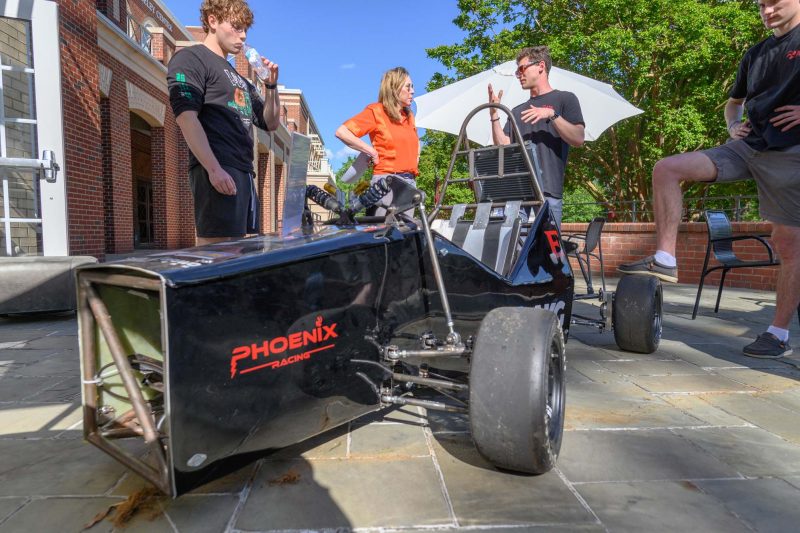
Members of the Phoenix Racing team talk with Maker takeover visitors in front of their electric F1 car

Is this program right for you?

For people who want to know how things work.

The B.S. in Mechanical Engineering fits if you enjoy figuring out why a system behaves as it does and want to use that understanding to improve it. You’ll study forces, materials, heat and motion, then make decisions about how they come together in a design. The required courses give you a foundation across the field. Your breadth choice and study elsewhere at Elon can help you apply it to the kinds of systems and problems that interest you.

Where a B.S. in Mechanical Engineering might lead

There are many combinations of courses that you can add to your degree path, and a wide range of professional opportunities. A few options are here, but talk with your advisor about a combination that fits the direction you're considering.

Products and manufacturing

Additional study in

  • Circuit Analysis
  • Machine Design
  • Manufacturing Engineering
  • Entrepreneurship and Innovation
  • Supply Chain Management

Possible role as

  • Mechanical Design Engineer
  • Manufacturing Engineer
  • Product Development Engineer

Robotics and automation

Additional study in

  • Controls and Dynamic Systems
  • Robotic Manipulation
  • Computer Science
  • Data Science

Possible role as

  • Robotics Engineer
  • Controls Engineer
  • Automation Engineer

Energy and sustainability

Additional study in

  • Engineering Thermodynamics
  • Heat and Mass Transfer
  • Environmental and Sustainability Studies
  • Sustainable Enterprises

Possible roles as

  • Energy Systems Engineer
  • Thermal Engineer
  • Sustainability Engineer

Your Faculty

Faculty traditionally associated with the B.S. in Engineering major.