

The B.S. in Engineering with an Electrical and Computer Concentration lets you explore how physical devices and computing work together. You build a broad engineering foundation, then study how circuits carry signals, how digital systems process information and how devices can respond to the world around them. Your course choices can take you toward electronics, robotics or connected devices, with room to bring in interests from elsewhere at Elon.

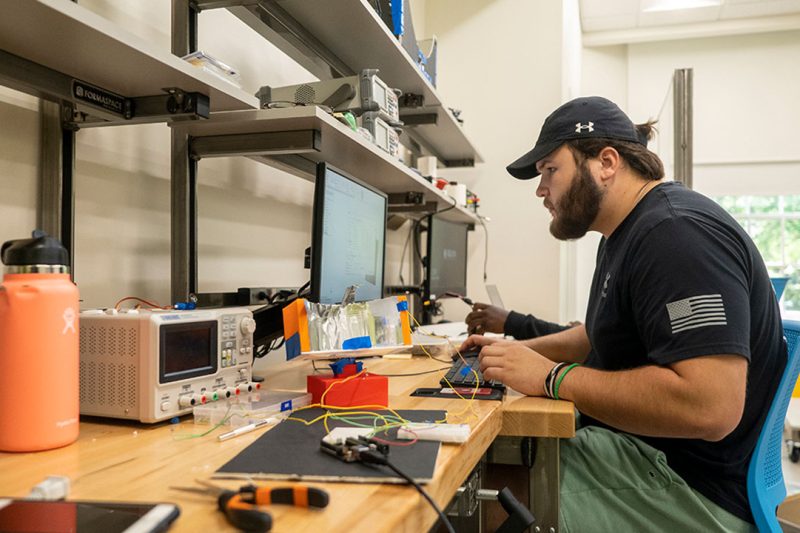
Student sits at work bench with computers, electrician's tools and various wires and boxes.

What You’ll Study

You’ll study mechanics, materials, computing and design, then choose from courses in circuits, microelectronics, digital systems, signals and controls. A senior design project gives you an opportunity to connect what you’ve learned and test how well a system works.
Major Requirements & Courses

The B.S. in Engineering with an Electrical and Computer Concentration is a 97 credit hour program. It combines mathematics and science with engineering foundations, design and 24 hours of selected courses in electrical engineering and computing. One computer science course may count toward those 24 hours.

Math & Science — 32 semester hours

  • General Chemistry I
  • University Physics I
  • University Physics II
  • Calculus I
  • Calculus II
  • Multivariable Calculus and Analytic Geometry
  • Differential Equations

Choose at least one additional course — 4 semester hours

  • Statistics in Application
  • Linear Algebra
  • Discrete Structures
  • Probability Theory and Statistics

Engineering Foundations & Design — 33 semester hours

  • Introduction to Engineering
  • Engineering Computing with MATLAB
  • Engineering Graphical Communication
  • Computer Science I
  • Engineering Mechanics – Statics
  • Engineering Mechanics – Dynamics
  • Engineering Design for Service
  • Structure and Properties of Materials
  • Senior Engineering Design I
  • Senior Engineering Design II
  • Senior Comprehensive Evaluation

Social Sciences & Humanities — 8 semester hours

Choose one economics and one ethics course. These courses may count toward the Elon Core Curriculum requirements. Possible options include the following courses. For other courses in this category seek approval of the Chair of the Engineering Department.

  • Principles of Economics
  • Statistics for Decision Making
  • Ethical Practice
  • Ethics and Decision Making
  • Environmental Ethics

Additional Major Requirements — 24 semester hours

Choose from the following courses. Only one Computer Science course may be counted.

  • Organization and Architecture
  • Computer Science II
  • Circuit Analysis
  • Circuit Analysis Lab
  • Microelectronic Devices and Circuits
  • Robotics
  • Signals and Systems
  • Digital Systems
  • Controls and Dynamic Systems

Your typical four-year plan

The recommended sequence shows how a full four-year course of study fits together.
You'll work with your advisor to find the right path for you.

Year One — 38 semester hours

Fall Semester

  • Calculus I
  • Writing: Argument and Inquiry or Global Experience
  • University Physics I & Lab
  • Introduction to Engineering
  • Orientation

Winter Term

  • Core Curriculum — Expression: Literature

Spring Semester

  • Calculus II
  • Global Experience or Writing: Argument and Inquiry
  • University Physics II & Lab
  • Computer Science I
  • Engineering Graphical Communication

Year Two — 34 semester hours

Fall Semester

  • Multivariable Calculus and Analytic Geometry
  • General Chemistry I
  • Engineering Mechanics – Statics
  • Engineering Design for Service
  • Engineering Computing with MATLAB

Winter Term

  • Core Curriculum — Civilization: History or Art History

Spring Semester

  • Differential Equations
  • Engineering Mechanics – Dynamics
  • Linear Algebra
  • World Language — Elementary I

Year Three — 36 semester hours

Fall Semester

  • Circuit Analysis & Lab
  • Robotics
  • World Language — Elementary II
  • Core Curriculum — Advanced Studies Outside the Major

Winter Term

  • Core Curriculum — Society: A Discipline Other Than Economics

Spring Semester

  • Structure and Properties of Materials
  • Microelectronic Devices and Circuits
  • Signals and Systems
  • Digital Systems

Year Four — 32 semester hours

Fall Semester

  • Senior Engineering Design I
  • Integrative Core Capstone Seminar
  • Free Elective

Winter Term

  • Core Curriculum — Advanced Studies Outside the Major

Spring Semester

  • Senior Engineering Design II
  • Controls and Dynamic Systems
  • Principles of Economics
  • Ethical Practice
  • Senior Comprehensive Evaluation
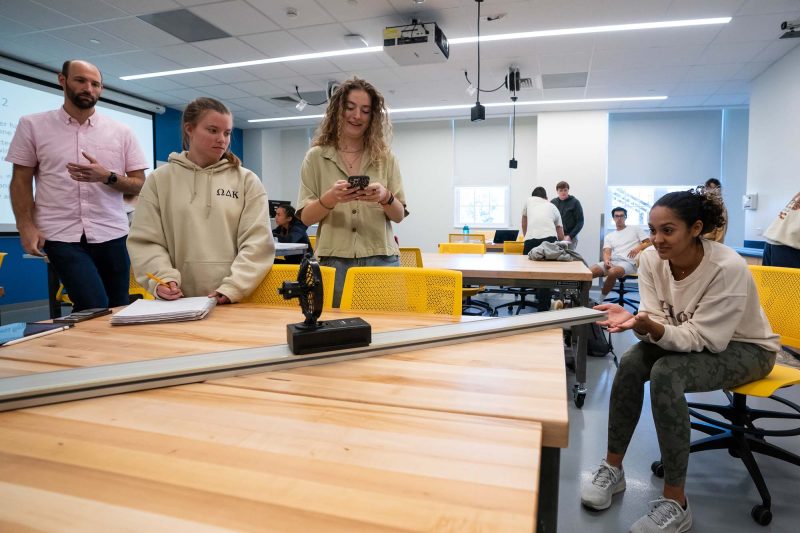
Students run an experiment with a fan-propelled device on a track

Is this program right for you?

Make the parts work together.

This concentration fits if you’re curious about both what a device does and what makes it respond. You might want to design electronic hardware, program a connected device or build a robot that senses and acts. The engineering core gives you tools to design and test a system; your selected courses let you focus on the parts that interest you most. Study elsewhere at Elon can help you consider the people who use that system and the problems it could help solve.

Where a B.S. in Engineering with an Electrical and Computer concentration might lead

There are many combinations of courses that you can add to your degree path, and a wide range of professional opportunities. A few options are here, but talk with your advisor about a combination that fits the direction you're considering.

Connected devices

Additional study in

  • Circuit Analysis
  • Digital Systems
  • Computer Science II
  • Human-Computer Interaction

Possible role as

  • Embedded Systems Engineer
  • Firmware Engineer
  • Hardware Integration Engineer

Robotics and automation

Additional study in

  • Robotics
  • Signals and Systems
  • Controls and Dynamic Systems
  • Data Science

Possible role as

  • Robotics Engineer
  • Controls Engineer
  • Automation Engineer

Health technology

Additional study in

  • Microelectronic Devices and Circuits
  • Bioinstrumentation and Imaging
  • Public Health
  • Entrepreneurship and Innovation

Possible roles as

  • Medical Device Design Engineer
  • Biomedical Instrumentation Engineer
  • Product Development Engineer

Your Faculty

Faculty traditionally associated with the B.S. in Engineering major.