

An Innovative Culture that Supports Children with Dyslexia
The creation of the Roberts Academy at Elon University offers a case study in how institutional culture can drive innovation from idea to implementation.
The academy’s mission is focused on serving children with dyslexia and families and its development at Elon University revealed something equally important: the systems, behaviors and leadership practices that allow new ideas to take root and scale.
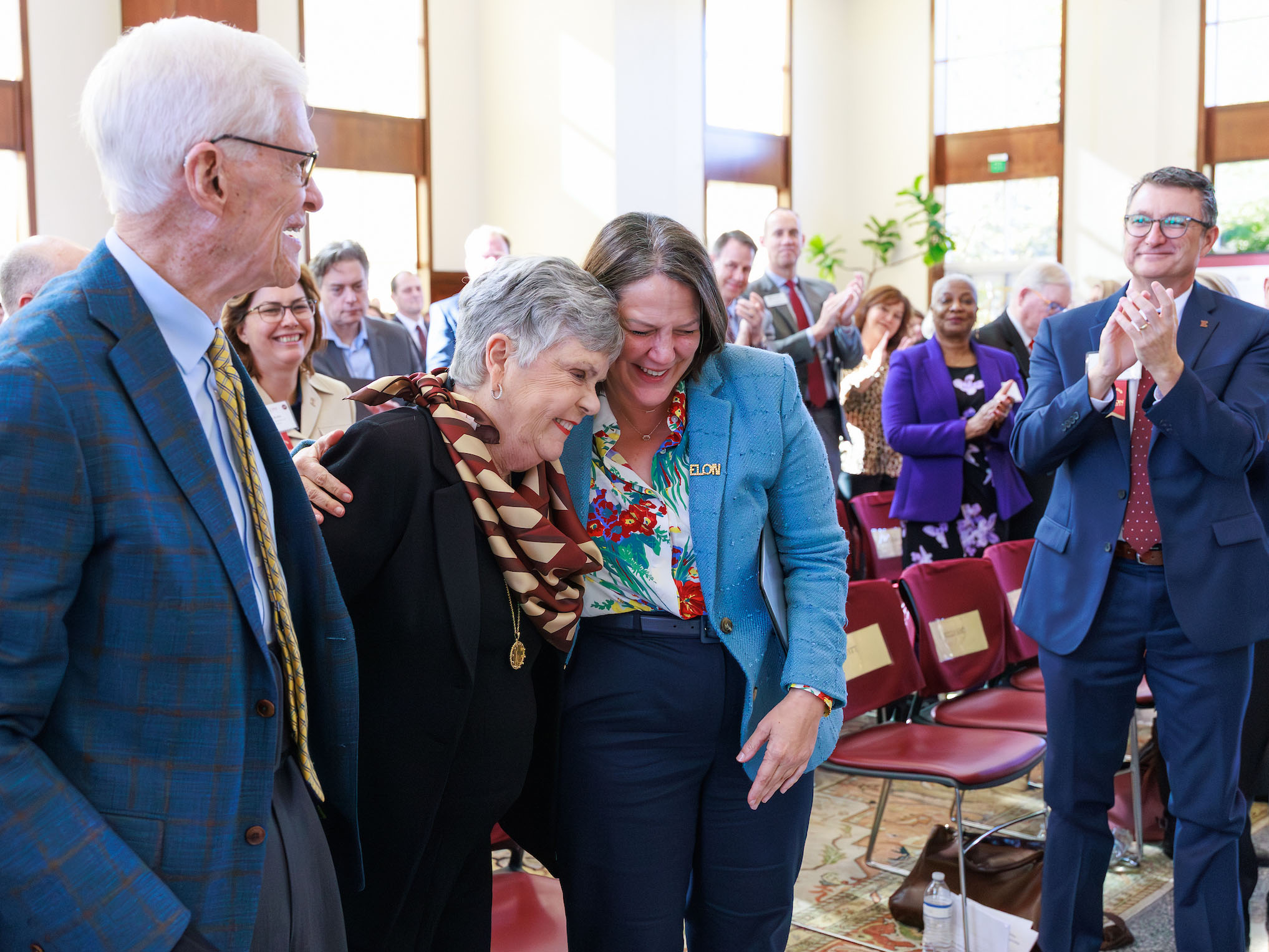
Elon University President Connie Ledoux Book embraces Marjorie Roberts at the formal public announcement of the Roberts Academy at Elon University. Hal Roberts (left) looks on with smiles.
Elon was selected last year as the fourth university in the country to host a Roberts Academy, a university-based private school for children with dyslexia grounded in the Orton-Gillingham approach to reading instruction. Similar programs were previously established at Vanderbilt, Mercer, and Florida Southern by philanthropists Hal and Marjorie Roberts. What followed at Elon was not just the creation of a school, but a demonstration of how institutional culture determines how quickly and effectively a vision comes to life.
That process began with alignment.
“At Elon, people understand they are working for the university as a whole,” said Ann Bullock, dean of Elon’s Dr. Jo Watts Williams School of Education. “You cannot do your job here without relationships with other people across campus.”
Systems where collaboration is expected rather than optional allows ideas to move fluidly across divisions. It also creates the conditions for tackling challenges that fall outside traditional models, such as launching a K-12 school within a university environment.
Equally important is a shared willingness to take on difficult challenges when they align with institutional purpose. The Roberts Academy requires new processes, new partnerships and new ways of thinking across the university, from information technology to human resources to facilities design and even campus safety.
“What I’ve seen is that people are willing to learn and adapt,” Bullock said. “The question is not ‘Can we do this?’ but ‘How can we do this?’”
If Bullock describes the structural conditions for innovation, Alicia Tate, assistant professor and acting director of the Roberts Academy, points to the human dynamics that sustain it.
In many organizations, Tate noted, large projects struggle to maintain momentum because contributors lack a direct connection to the outcome. At Elon, that barrier has been addressed through intentional storytelling and leadership.
“People understand the impact this will have on children and families,” Tate said. “That sense of purpose brings people in, even if they won’t be involved day to day long term.”
People understand the impact this will have on children and families. That sense of purpose brings people in, even if they won’t be involved day to day long term.
Leadership, she added, plays a critical role in translating that purpose into action. By clearly communicating the vision and empowering teams to contribute beyond their formal roles, leaders have created an environment where initiative is expected.
“I haven’t heard anyone say, ‘That’s not my job,’” Tate said. “Instead, it’s, ‘Let me help,’ or ‘Here’s who you should talk to.’”
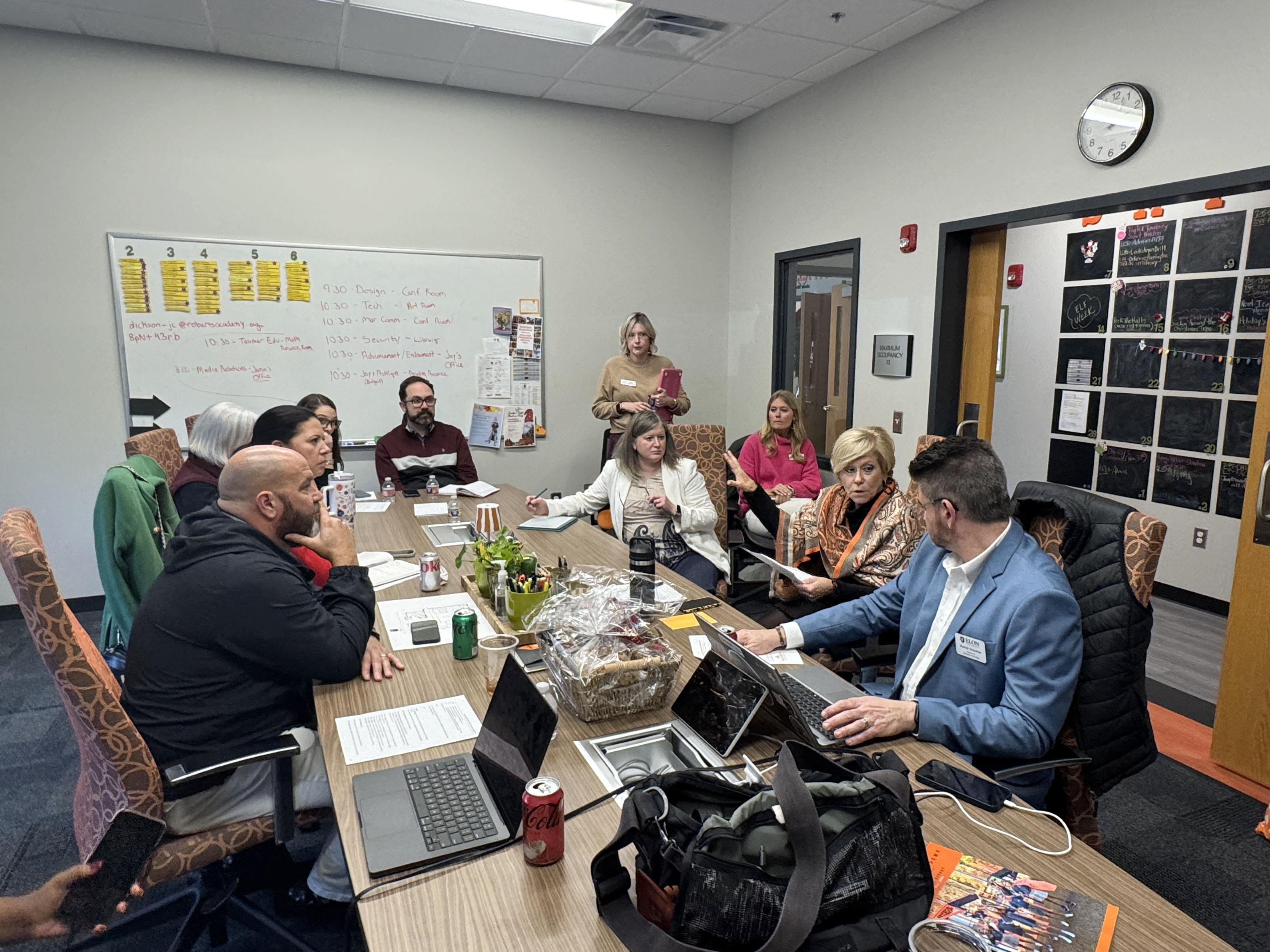
Faculty and staff from Elon University traveled to Macon, Georgia, in December 2025 to visit with educators and leaders of the Roberts Academy at Mercer University.
For Pat Donohue, Elon University’s deputy CIO, the Roberts Academy also highlights another dimension of innovation: design grounded in experience. Rather than defaulting to existing systems or off-the-shelf solutions, Donohue said teams have focused on understanding how the school will function and then building accordingly.
“It’s not about picking something from a catalog,” Donohue said. “It’s about understanding how it will be used and designing around that.”
That approach was shaped in part by visits to other Roberts Academy campuses, where Elon teams observed classrooms, interacted with students and experienced the learning environment firsthand. “You have to see the facility and the classroom environment, you have to feel it,” Donohue said. “Once you do, you start thinking differently about what’s possible.”
Shared experiences allowed team members from across disciplines to collaborate more effectively, generating ideas that reflect Elon’s specific context rather than simply replicating existing models. “The innovation comes from that cross-pollination,” Donohue said. “You’re not just copying — you’re adapting and improving.”
Equally important is a culture that invites contribution from all participants.
“There are low barriers to sharing ideas here,” he said. “People feel comfortable speaking up, even outside their area.”

The Trollinger House at Elon University will serve as the temporary home of the Roberts Academy until a new school is built on campus in time for the 2028-29 academic year.
KEY TAKEAWAYS
- Align people around institutional purpose.
When individuals see themselves as contributing to a shared mission rather than a single unit, collaboration becomes the default and complex projects can move more quickly. - Use purpose-driven storytelling to activate participation.
Clearly communicating the real-world impact of a project helps engage contributors across roles, sustaining momentum even among those without direct long-term involvement. - Design through shared, firsthand experience.
Innovation is strongest when teams observe and engage with the environments they are building for, allowing insights from real users to shape decisions and drive continuous improvement.