

The spring 2024 Power + Place community gathering created a space for over 90 members of the Alamance community to come together and explore the rich wisdom of our shared stories, collective embodied knowledge, and explore opportunities to create social change.
Attendees included over 15 Power + Place storytellers and members, 15 diverse faith communities, approximately a dozen university students, 10 Elon faculty, five nonprofit organizers, five members of the creative community, a number of government representatives, educators, and county youth. Overall, those in attendance represented a rich cross-section from across Alamance County, encompassing diverse faith traditions; racial, ethnic, national, and socioeconomic backgrounds; and linguistic differences; as well as spanning multiple generations.
The evening was facilitated by Savannah Keith Gress and Victor Udoewa. Savannah Keith Gress is an independent consultant who works with communities to end systems of oppression and cultivate liberation. Victor Udoewa is a civic designer for the federal government helping to improve the government’s policies, products, and services for the public. Both bring expertise in Radical Participatory Design and Relational Design practices that harness arts- and asset-based methods for supporting community-identified goals and systems change.
The evening built upon insights from the Power+Place fall 2023 public screening and community dialogue where a hope that more stories and experiences from marginalized communities could continue to be heard. Attendees explored how fractures and divides across Alamance County have led to being stuck in a cycle of inequitable community development across the county, especially in education, housing, and transportation with county and city government only representing some communities.
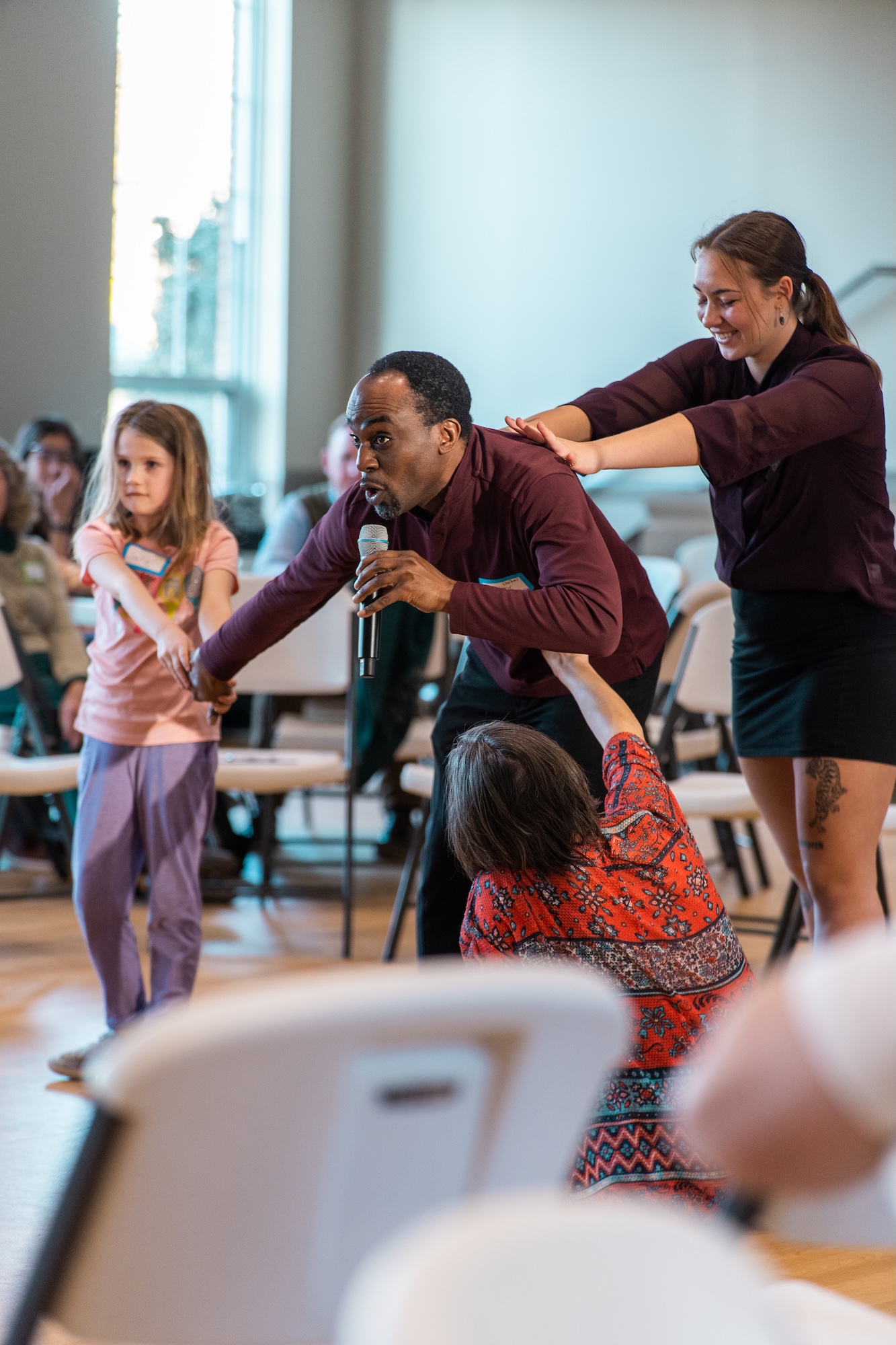
After a brief introduction to the Power+Place collaborative, attendees connected in small groups of three to five to practice social presencing theater (SPT) activity called “Individual Stuck”: A practice where you can embody situations in which you feel stuck and explore through your body what it would feel like to get ‘unstuck.’ After practicing this activity together, attendees discussed what they observed and felt through the activity.
Attendees were then invited to participate in Community 4D Mapping (an SPT activity). They were given opportunities to embody, sense, and afterward discuss the current reality of the system of inequitable development across the county and the diverse roles and experiences across the county. Individuals came forward to embody the experiences of community members from diverse groups including East and West Burlington, educators, faith communities, Latinx communities, Native American communities, artists, local businesses, nonprofit organizations, and the county government.
As attendees embodied physical forms that visualized the system of inequitable county development, they shared a single sentence from the perspective of the role they embodied. For instance, A local high school teacher representing Alamance educators held one hand high to the air, while positioning his other hand towards the floor and said, “we will lift some of them up.” The individual representing the Alamance government wrapped their arms together and said, “my hands are tied.” A full list of descriptions can be found in the table below.
After all attendees embodied the ways in which they felt stuck within the current social systems, they were invited to sense into an aspirational future, an emerging reality, what it might feel like to healthily and sustainably move towards a more connected and supportive future. Slowly attendees moved across the large circle, some more than others, and explored actions like moving closer to others and physically reaching out. As movement slowed and the new future reality solidified into a new group sculpture, they were again invited to share a short phrase that helped observers understand their embodied role in the new system.
| Systems Role | Sculpture 1 | Sculpture 2 |
| Alamance government | “My hands are tied.” | “I am thinking about how much this is going to cost.” |
| Artists / Creatives | “I am trying to inspire.” | “We can grow.” |
| Black Christian Church | “I am hopeful.” | “Everyone is welcome.” |
| Burlington City Council | “I do not want to say anything.” | “I want to include.” |
| Business/entrepreneurs | “I wish the economy was growing stronger.” | “I recognize all people.” |
| East Burlington | “I am forgotten.” (seated on the ground) | “I want to be seen” (Stood up first) |
| Educators | “We will lift some of them up.” | “I couldn’t hold it anymore.” (Sat down) |
| Elon University faculty/staff | “I feel overstretched.” | “Helping Alamance educators.” |
| Elon University student | “I tend to ignore my privilege.” | “I should strive to be more involved.” |
| Health care | “I am trying to reach out.” | “I see most, but not all.” |
| Latinx Community | “I am trying to adapt & find my place.” | “I have so much to give. I need more space.” |
| Law enforcement | “I can’t hear you.” | “I’m just watching.” |
| Legal system | “I have codified the patriarchy.” | “Tired of a broken system.” |
| Long time county resident | “I don’t want to change.” | “I want a Bucee’s.” |
| Muslim community | “I am misunderstood.” | “I feel more welcome and I want to welcome others.” |
| Native American | “I feel powerless.” | “I look forward to all the help.” |
| New(er) resident | “I feel unwelcome.” | “I want to find my place.” |
| Nonprofit & social center | “I am TRYING to help.” | “I’m giving everything I can.” |
| Rural Alamance | “I like things as they are.” | “I’m digging my heels in.” |
| West Burlington | “Everything looks perfect.” | “No response.” |
| White Christian Church | “I don’t see the problem.” | “I want to give a hug to everyone.” |
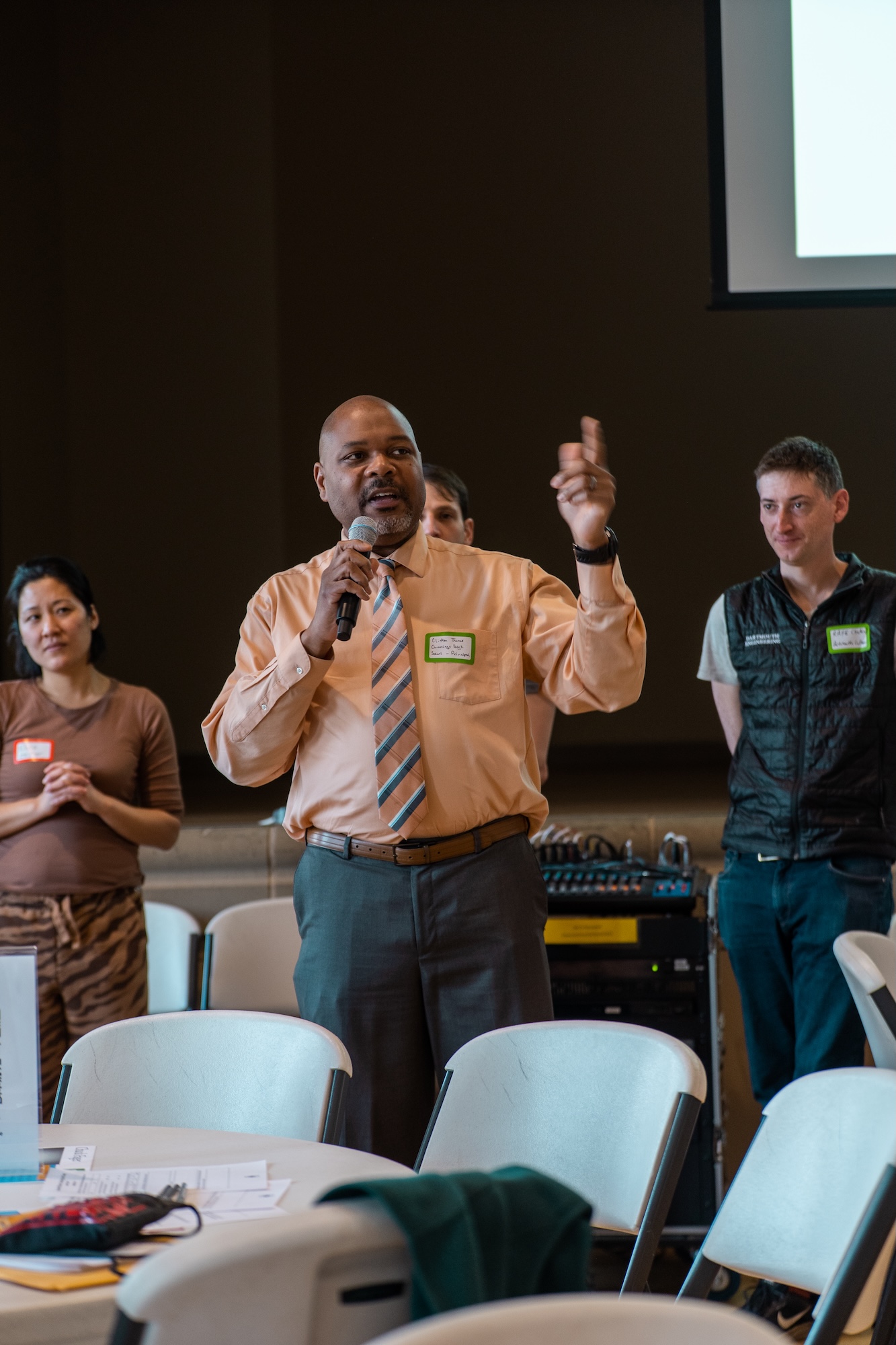 In this second sculpture we reflected upon where people were in the system and where change might be valuable. We also explored how we move forward when some have hope and others do not. For instance, a Latinx community member originally said, “I have so much to give” while a resident of East Burlington said, “I want to be seen.”
Participants were then invited to reflect upon the social systems presencing theater together. Reflections included:
- “I saw the possibility.”
- “I saw bridge builders.”
- “I saw a shifting towards empowerment for many communities, but not all.”
- “I saw the environment trying to make its presence known.”
- “I feel the pain of the homeless.”
- “East Burlington stood up and moved first.”
- “Burlington City Council sought to help educators out of their stuckness.”
- “Business owners reached out to new residents.”
- “I built bridges and decentered myself.”
As facilitator Victor Udoewa noted that the County “unstuck sculpture” still embodied significant gaps that participants did not see how to bridge. However, in one final reflection, a community member noted that when you look up and look around, our individual burdens might become shared opportunities for mutual support and community transformation.
In addition to sharing their insights via dialogue and written reflection, 20% (18/90) of attendees completed the post-event assessment, sharing their perspectives on what they valued and what next steps they would recommend the Collaborative pursue.
Over 94% of respondents affirmed the evening was successful
100% of respondents said they made a deeper connection with someone from a different background.
88% of respondents learned about a community organization or initiative they had not known before.
When asked what specific activities or statements stood out to them, respondents noted that they came to see that certain groups faced more barriers than others and that being vulnerable together and seeing together is necessary for next steps.
They also noted that they most valued how this event provided an opportunity to be together in discomfort and explore opportunities for collective change, not that more time together to explore future possibilities would be valuable.
The Collaborative plans to continue their storytelling and dialogue efforts into 2024, with a storywalk campaign unfolding in the spring and a fall public screening of community stories.
This program and project was made possible by grants from Impact Alamance, Elon’s Fund for Excellence, and North Carolina Humanities, a statewide nonprofit and the state affiliate of the National Endowment for the Humanities.