A Bit (or a Few Bytes) of Background
It took a team to build the Elon University/Pew Internet Predictions
Database - Imagining the Internet - a three-section resource including
thousands of voices making thousands of predictive pronouncements
about the future of networked communications.
The
research was inspired by a suggestion from Lee Rainie,
director of the Pew Internet & American Life Project, during
a visit to Elon University in 2000. He spoke then with School
of Communications faculty members Janna Quitney Anderson
and Connie Ledoux Book about his idea to assemble
a database of predictions. It had been inspired by Ithiel de Sola
Pool's research work "Forecasting the Telephone."
In 2001, Book undertook a small preliminary study funded by
Pew Internet. She and her research assistants used several search
terms such as "Internet" and "Future" to seek
predictions made between 1993 and 1995 in the Lexis-Nexis database.
Book's ensuing 2002 research report, an analysis of several hundred
predictive statements, established the following major themes:
The Internet will transform society; it will transform economies;
content will drive the Internet's success; the Internet presents
security and privacy concerns; the Internet's growth is dependent
on an efficient and reliable infrastructure; the Internet will
spawn a new generation of hardware and software; the Internet
will create a smaller world; the Internet will transform America's
schools; the Internet will impact professions.
This first report, "Forecasting the Internet: A Retrospective
Technology Assessment," was used in 2003-2004 as the base
from which Anderson built an ensuing study aimed at assembling
a large, thorough, public database of thousands of predictions
made between 1990 and 1995. This more comprehensive study targeted
statements made by Internet stakeholders and skeptics, and it
included searches through major books of the time, Internet sites,
magazines, speeches, research presentations and newspaper articles.
(None of the predictions logged in Book's initial study were slotted
into this online database; the Elon/Pew Predictions Database was
started from scratch in order to begin with a clean slate, utilizing
a more detailed method of searching, identifying, mining and sorting
the data.) The 1990 to 1995 Predictions Database is not exhaustive;
there are predictive statements that went unlogged; the collection
is a representative sample.
Upon the completion of the early 1990s predictions database,
Rainie's continuing, enthusiastic support led to the further development
of the Predictions site with the additions of the Experts Survey
and Share Your Vision elements.
In the fall of 2004, a number of the experts quoted in the early
1990s database were sent an e-mail invitation to participate in
a web-based Experts Survey recording their thoughts about changes
to come in the decade ahead; these experts were asked to invite
other friends and associates to also take the survey. Nearly 1,300
people responded. The survey was compiled, conducted and assessed
by Rainie and Susannah Fox of Pew Internet, Anderson
of Elon University, and the team at Princeton Survey Research
Associates. Results were revealed to the public in January 2005.
The Share Your Vision section of the site is an open invitation
to the public to share their thoughts about the future of networked
communications. This growing element of the site had more than
500 responses logged by the end of 2004.
About the site's director
Janna
Quitney Anderson is an assistant professor at Elon University's
School of Communications. Her expertise is concentrated in the
fields of internet history; the future of the internet; and print/online
journalism. She has directed two major studies for the Pew Internet
& American Life Project: the Internet Predictions Database
and a 2001 ethnographic study of the use of the internet by small-town
families (www.elon.edu/pew/oneweek). She is the author of the
book "Imagining the Internet: Personalities, Predictions,
Perspective," forthcoming from Rowman & Littlefield in
August 2005. She joined the faculty at Elon in 1999, following
a 20-year career as an editor and reporter for daily newspapers
in Minnesota and North Dakota. She has written articles for the
New York Times News Service, USA Today, Newspaper Research Journal,
Operant Subjectivity, College Media and Advertising Age. She is
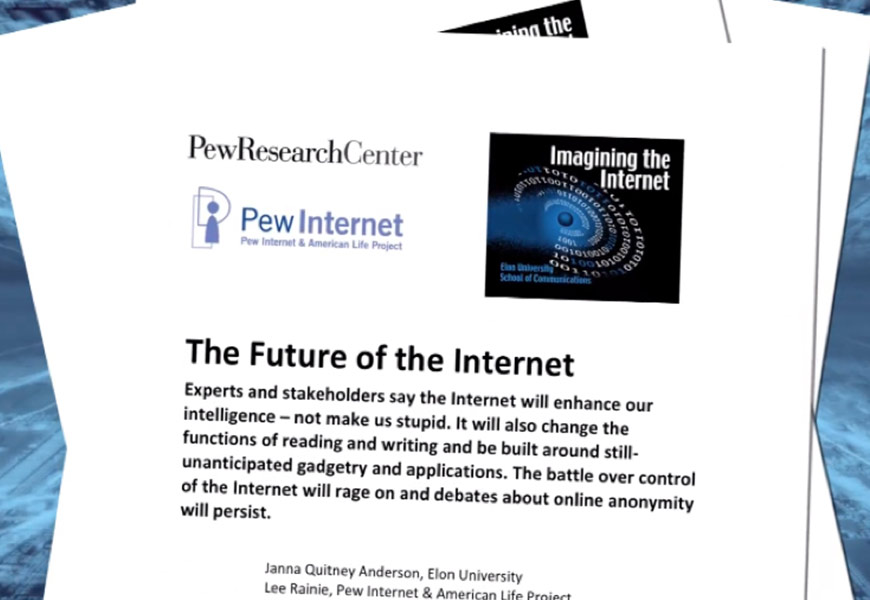
also a co-author of the 2005 Pew Internet report "The Future
of the Internet."
Anderson's 2000 research report on editing and ethics at online
newspaper operations received world and national media attention,
including coverage on the ABC Radio Network and in USA Today,
Editor & Publisher Online, the Freedom Forum Web site and
on many other outlets. Her website on ethics for digital information
providers is a resource used by thousands of people annually.
She also served as a consultant for the Online News Association's
credibility study in 2001. She has been recognized with national
awards for web design from the Association for Education in Journalism
and Mass Communication and the Broadcast Education Association.
Her research/teaching areas include the internet, newswriting,
editing and ethics. She earned her MA at the University of Memphis.
Other members of Elon's database-building team:
Connie Ledoux Book, the author of Elon's first
study of 1990s Internet predictions, is an associate professor
at Elon University. In addition to her work on Internet issues,
her research focuses on digital television and cable policy and
regulation. She has been the recipient of several grants from
the National Association of Broadcasters and is the author the
book "DTV: Digital Television and the Consumer" (Blackwell,
2004).
Dean Paul Parsons of Elon University's School
of Communications lent support to the project in myriad ways.
Harlen Makemson, an assistant professor at Elon,
agreed to ask his Media History students to take part in the data-mining
effort for the early 1990s database as part of their course work
and helped explain the complicated methodology. Thanks to Makemson,
more than 60 Elon University students each spent 18 hours or more
seeking, finding and logging predictive data under the direction
of Anderson. The students' work constitutes more than a quarter
of the found predictions database listings (the students' names
are listed below on this page).
Kate Hickey, director of Elon University's
Belk Library, gave the project workspace and support. Research
librarian Betty Garrison dedicated months of
effort to aiding students and finding materials; in addition,
she mined and logged many predictions herself. David Morton
and the Elon University PC Support crew helped acquire equipment
and keep things running. Former Elon faculty member Nadia
Watts and 2003 Elon graduate Jennifer Guarino
made significant contributions in editing or inputting data. Elon
University's Academic Council donated the space in the faculty
resource center from which the student contributions were coordinated.
School of Communications staff members Phyllis Phillips
and Pam Baker also lent a hand.
The Predictions Database site was conceived and is directed
by Janna Quitney Anderson with database and Web
page design assistance from Dan Anderson, director
of university relations at Elon. Database programming and design
assistance was also provided by university relations staff members
Alex Lindgren and Richard Puchyr.
Student contributors
Elon University student researchers participating in logging the
predictive data on this site included:
Crystal Allen
Patrick Allen
Justen Baskerville
Angela Beckett
Natalie Bizzell
John Bolger
Jason Boone
Lindsay Bradshaw
Erin Bricker
Marian Bruno
Jay Burnham
Lawrence Butler
Lauren Canizaro
Cara Catalfumo
Jason Chick
Kaci Collier
Theresa Cooley
William Culp
Jay Dorne
Kristen Dube
Elizabeth Edwards |
Peter Falcone
Peter Fedders
Adam Garber
Barbara Goodrich
Mathea Gulbranson
Nichelle Harrison
Abbey Heiskell
Shavanna Jagrup
Kathleen Johnson
David Kafoure
Tiffany Kildale
Kelly Kohlhagen
Anne Komorowski
Kevin Krout
Ellie Lightburn
Brandi Little
Travis Lusk
Casey Marge
Rory McAlister
Jennifer Meyer
Erin Moseley |
Diana Nolan
Shawna Pagano
Bradley Pinkerton
Kristin Ries
Melanie Sampson
Nicholas Schmidt
Carrie Scott
Tim Severs
Ian Smith
Barry Smoot
Shawn Stevens
Ben Stewart
Larry Stotler
Amanda Strickland
Matt Sturmfelz
Kellen Taylor
Elizabeth Tencer
Evelyn Uhlfelder
Amanda Vellucci
Abigail Wahl
Meghan Walsh
Laura Wright |