Elon/Pew Publications

Use this page to link to an excerpt from our book and to download PDFs of some of our most popular short publications and reports.

Download Free Publications
Click any of the following to download a PDF version.

Forward 150 Years (21-page assessment of our potential future)
Back 150 Years (a 24-page look at recent communications history)
KidZone Highlights (12 pages of education and entertainment)
Teachers' Tips (13 pages of tools and ideas for teaching about the future)
2004 Predictions Survey (62-page report sharing prognostications)
2006 Predictions Survey (115-page report)

View a Powerpoint Presentation
Click here to see a 60-slide show about the content on the Imagining the Internet website.

Books generated by Imagining the Internet projects

Up for Grabs: The Future of the Internet I

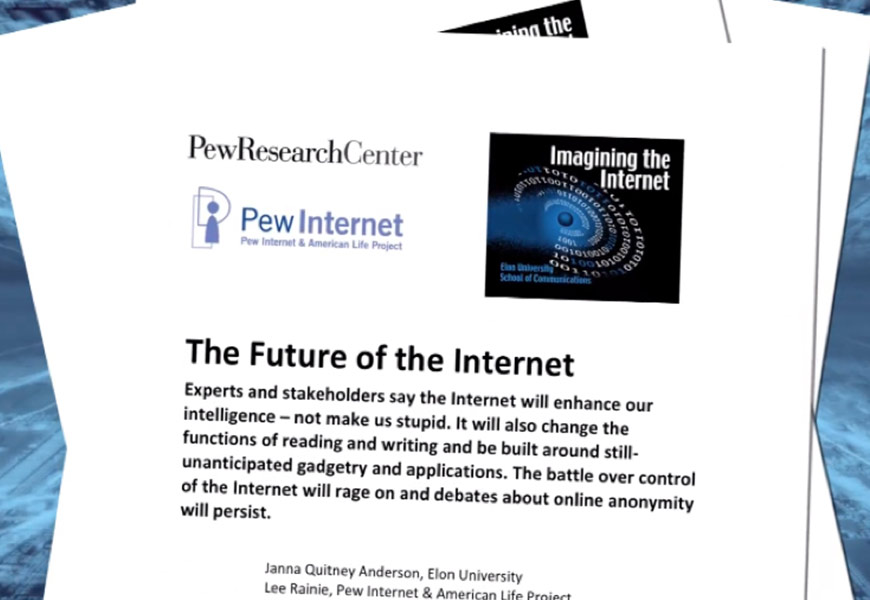
In brief: "Up for Grabs"  (Cambria Press) is a print volume - number one in a series - that includes most of the data generated for the first "Future of the Internet" survey conducted by Elon University and the Pew Internet & American Life Project. How will the Internet be expected to change the workplace, family life, education and many other foundations of society between 2004 and 2014? Profoundly. That was the forecast of nearly 1,300 leading technology experts and scholars who responded to The Future of the Internet I, a 2004 survey by researchers at the Pew Internet & American Life Project and Elon University.

The title of the second book in the series is "Hopes and Fears." It is a compilation of detailed results from the second Future of the Internet survey. The third book in the series is already in the early stages of production, and it should be released in 2009.

The extensive elaborations supplied by Future of the Internet survey respondents provide a vision of a networked, digital future that enhances many peoples' lives but also has some distressing, even dangerous, implications.

The big-picture Internet issues of the next decade, as foreseen by the experts in these surveys, include: positive and negative changes in the family dynamic; a conflict between our desire for privacy, security and ownership of intellectual property and our desire for the convenience of free information sharing on networked devices; and a concern over being inundated with information. You can order the books directly from the publisher, Cambria Press, online or from online retailers such as Amazon.

For more details, click here.

description Imagining the Internet
Click here to read excerpts from each chapter
Selected by the American Library Association as a "Choice" book for 2006 - named an outstanding academic title - in the top 10 percent of works published.

In brief: "Imagining the Internet: Personalities, Predictions, Perspectives" (Rowman & Littlefield), is a print book that serves as a companion to this database. In addition to offering a large collection of quotable forecasts from tech luminaries of the 1990s, it includes a brief history lesson and a deep look at the future of pervasive networks of all kinds, incorporating the stories of Six Degrees, the Romantics, the Utopians, technorealists, gaia, and a projected battle between Cosmists and Terrans over a future in which artilects may dominate the galaxy. It shares concepts of such thinkers as Ithiel de Sola Pool, Vannevar Bush, Duncan Watts, Albert-Laszlo Barabasi, and Isaac Asimov while parsing the thoughts of Bill Gates, Nicholas Negroponte, John Perry Barlow, Bruce Sterling, Clifford Stoll, Al Gore, and dozens of other networked communications stakeholders and skeptics. The book can be ordered (softcover for under $30; hardcover about $75) from online retailers, including Barnes & Noble and Amazon.com or you can order it directly from Rowman & Littlefield online.

Recommendations for "Imagining the Internet"

"Janna Anderson offers a great perspective on the history and future of the Internet based on Elon University/Pew Internet & American Life Project's extensive prediction collection. Good books come from thorough research. Starting with the earliest communications systems, such as the telegraph, is a useful bonus. Being a part of and having the last word in this fine past-and-future Internet chronicle is a real honor."- Gordon Bell, vice president of research and development, DEC; leader of the National Science Foundation's Information Superhighway Initiative; senior researcher, Microsoft

"There are many books on the Internet and cyberculture - part hype, part gloss, sometimes solid technology criticism. Anderson's book is valuable because it helps sort out differing viewpoints and puts them in a historical context, recreating many of the ups and downs of the 1990s, before things got really crazy. She has an amazing database of predictions, collected over time, and selects from it well. This book is never dense reading, but it is packed with interesting facts and milestones to jar my memory, to help me recreate what that time was like, because the subtle changes are what have worked us over so thoroughly. My favorite part in these excursions into the words of technology prophets and critics is picking out the threads that had an influence - that helped shape the larger visions of what this massive commons has become." - Christine Boese, cyberculture columnist, CNN.com; writer, CNN Headline News

"Janna Anderson illuminates with great clarity the history, dreams, and challenges of the Internet, which allow the reader to see glimpses of the future. A wonderful and important contribution."- Tiffany Shlain, founder and chair, the Webby Awards

"Anderson examines the sometimes prescient, sometimes humorously off-base predictions made about the possible evolution of the Internet during the early 1990s... Anderson's knowledge is encyclopedic, and her accessible, jargon-free style - reminiscent of New York Times science writer Gina Kolata's - will engage professors and researchers without alienating undergraduates. Like the essay anthology 'Web.Studies,' ed. by David Gauntlett and Ross Horsley, and Katie Hafner's historical text 'Where Wizards Stay Up Late: The Origins of the Internet,' this book would make a choice acquisition for any library's technology section. Summing Up: Highly recommended. All readers." - M.E. DiPaolo,in a review for CHOICE, published by the American Library Association

"[Imagining the Internet] looks at the future through an analysis of the past. It is somewhat difficult after becoming immersed in these insights to remember that Internet communication began with the utmost diffidence. Indeed the first events involved a computer crash and unmemorable twaddle. ... We hope that this material will be useful to scholars who wish to assess the distance we have come; journalists who are trying to figure out where we are now; government, industry, and nonprofit officials who want to build the Internet of the future; and people of all walks of life who must learn to recognize the coming complexities of their networked world."- Lee Rainie, director, the Pew Internet & American Life Project, from the Foreword