| 
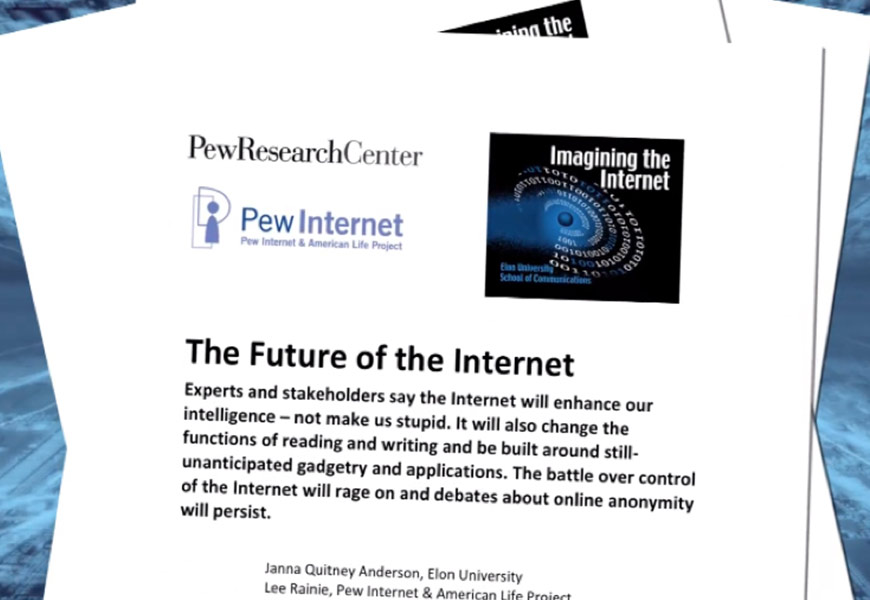
How will the internet change our lives
between 2004 and 2014? A survey of 1,286
network-technology stakeholders conducted by Elon
University and the Pew Internet Project in the fall of
2004 harvested thousands of projections of what's to
come in the next decade. Participants included people
from Internet2, Microsoft, Oracle, RAND, AOL, IBM, the
FBI, the FCC; Stanford, the University of California at
Berkeley, Harvard, and many other top universities; the
Mayo Clinic, SBC, AT&T, Gartner, Jupitermedia and
hundreds of other entities. Participating respondents
included people from France, Australia, Japan, Canada,
Nigeria and around the world. Nearly half of the
respondents began using the Internet prior to 1993,
including about 6 percent who began using it in 1982 or
earlier, and 38 percent who began using it sometime
between 1983 and 1992. Survey questions were asked in a
web-based instrument that was sent to specific Internet
stakeholders who were also asked to share the survey with
friends. Respondents were asked to react to 18
thought-provoking questions or statements. This page of
the Imagining the Internet Predictions Database includes
22 links to a variety of detailed information tied to the
2004 study.
To get a brief look at the results,
Much more detailed responses are available
on this site at the links below.
"Up for Grabs: The Future of the Internet I"
is a book-length version of the survey data, now available from Cambria Press. Its 436 pages include an expanded look at the survey data and a comprehensive set of expert responses on all of the cutting questions addressed in this study.
To read supplemental
information not contained in the official report -
including a large selection of the hundreds of
fascinating written responses by Internet stakeholders to
each of the survey questions/statements - look at
the listing below, and click on each topic of interest to
you. Included are biographies of some respondents and an
explanatory background for the wording of the survey
questions.
An
-
Respondents were asked to answer the following question:
In the next decade, which institutions and human
endeavors will change the most because of the internet?
Tell us how you see the future unfolding.
Prediction on
- Respondents shared their reactions to
the following statement: By 2014, use of the Internet
will increase the size of peoples' social networks
far beyond what has traditionally been the case. This
will enhance trust in society, as people have a wider
range of sources from which to discover and verify
information about job opportunities, personal services,
common interests and products.
Prediction on
-
Respondents shared their reactions to the following
statement: At least one devastating attack will occur in
the next 10 years on the networked information
infrastructure or the country's power grid.
Prediction on
- Respondents shared their reactions to
the following statement: In 2014, it will still be the
case that the vast majority of internet users will easily
be able to copy and distribute digital products freely
through anonymous peer-to-peer networks.
Prediction on
- Respondents shared their reactions to
the following statement: Civic involvement will increase
substantially in the next 10 years, thanks to
ever-growing use of the Internet. That would include
membership in groups of all kinds, including
professional, social, sports, political and religious
organizations - and perhaps even bowling leagues.
Prediction on
- Respondents shared their reactions to
the following statement: As computing devices become
embedded in everything from clothes to appliances to cars
to phones, these networked devices will allow greater
surveillance by governments and businesses. By 2014,
there will be increasing numbers of arrests based on this
kind of surveillance by democratic governments as well as
by authoritarian regimes.
Prediction on
- Respondents shared their reactions to
the following statement: Enabled by information
technologies, the pace of learning in the next decade
will increasingly be set by student choices. In ten
years, most students will spend at least part of their
“school days” in virtual classes, grouped
online with others who share their interests, mastery,
and skills.
Prediction on
- Respondents shared their reactions to
the following statement: By 2014, network security
concerns will be solved and more than half of American
votes will be cast online, resulting in increased voter
turnout.
Prediction on
-
Respondents shared their reactions to the following
statement: By 2014, as telework and homeschooling expand,
the boundaries between work and leisure will diminish
significantly. This will sharply alter everyday family
dynamics.
Prediction on the
- Respondents shared their reactions to
the following statement: Groups of zealots in politics,
in religion, and in groups advocating violence will
solidify, and their numbers will increase by 2014 as
tight personal networks flourish online.
Prediction on
-
Respondents shared their reactions to the following
statement: By 2014, most people will use the Internet in
a way that filters out information that challenges their
viewpoints on political and social issues. This will
further polarize political discourse and make it
difficult or impossible to develop meaningful consensus
on public problems.
Prediction on
- Respondents shared their reactions to
the following statement: In 10 years, the increasing use
of online medical resources will yield substantial
improvement in many of the pervasive problems now facing
healthcare - including rising healthcare costs, poor
customer service, the high prevalence of medical
mistakes, malpractice concerns, and lack of access to
medical care for many Americans.
Prediction on
and media environment
- Respondents shared
their reactions to the following statement: By 2014, all
media, including audio, video, print, and voice, will
stream in and out of the home or office via the Internet.
Computers that coordinate and control video games, audio,
and video will become the centerpiece of the living room
and will link to networked devices around the household,
replacing the television's central place in the
home.
Prediction on
-
Respondents shared their reactions to the following
statement: Pervasive high-speed information networks will
usher in an age of creativity in which people use the
Internet to collaborate with others and take advantage of
digital libraries to make more music, art, and
literature. A large body of independently produced
creative works will be freely circulated online and will
command widespread attention from the public.
Prediction about
- Respondents shared their reactions to
the following statement: By 2014, 90% of all Americans
will go online from home via high-speed networks that are
dramatically faster than today's high-speed
networks.
Looking back:
- Respondents answered this
question: Thinking back to your views a decade ago, where
has the use or impact of the Internet fallen short of
your expectations?
Looking back:
- Respondents answered this question: What
Internet impacts have been felt more quickly than you
expected?
- Respondents answered these questions:
What are you anxious to see happen? What is your dream
application, or where would you hope to see the most
path-breaking developments in the next decade?
Use this link to
about the 2004 Predictions Survey.
Use this link to
relating to how the questions were
formulated.
Use this link to read
of some of the survey
respondents.
|
|