


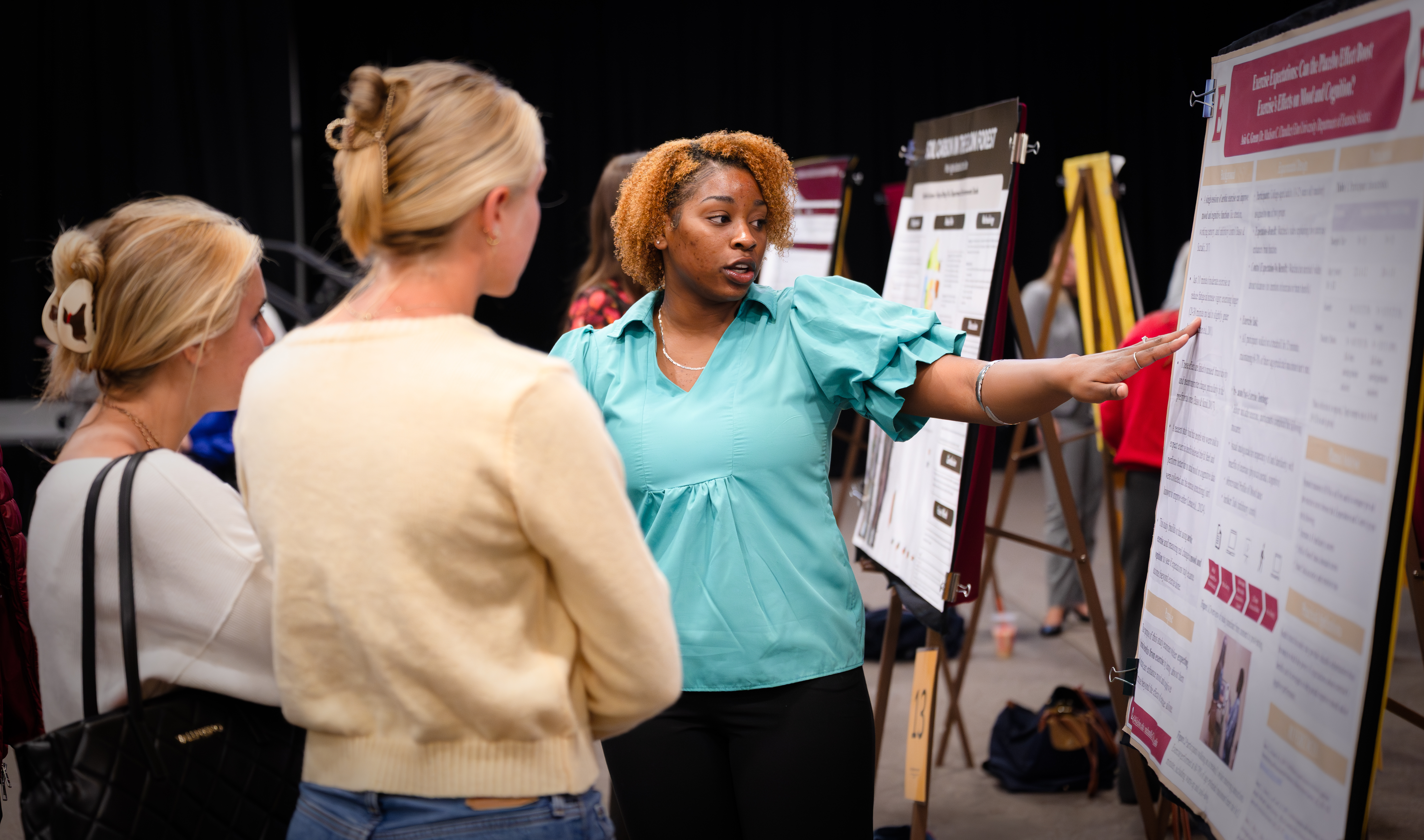
The signature campus event provides an opportunity for Elon students to showcase their undergraduate research, one of the five Elon Experiences.
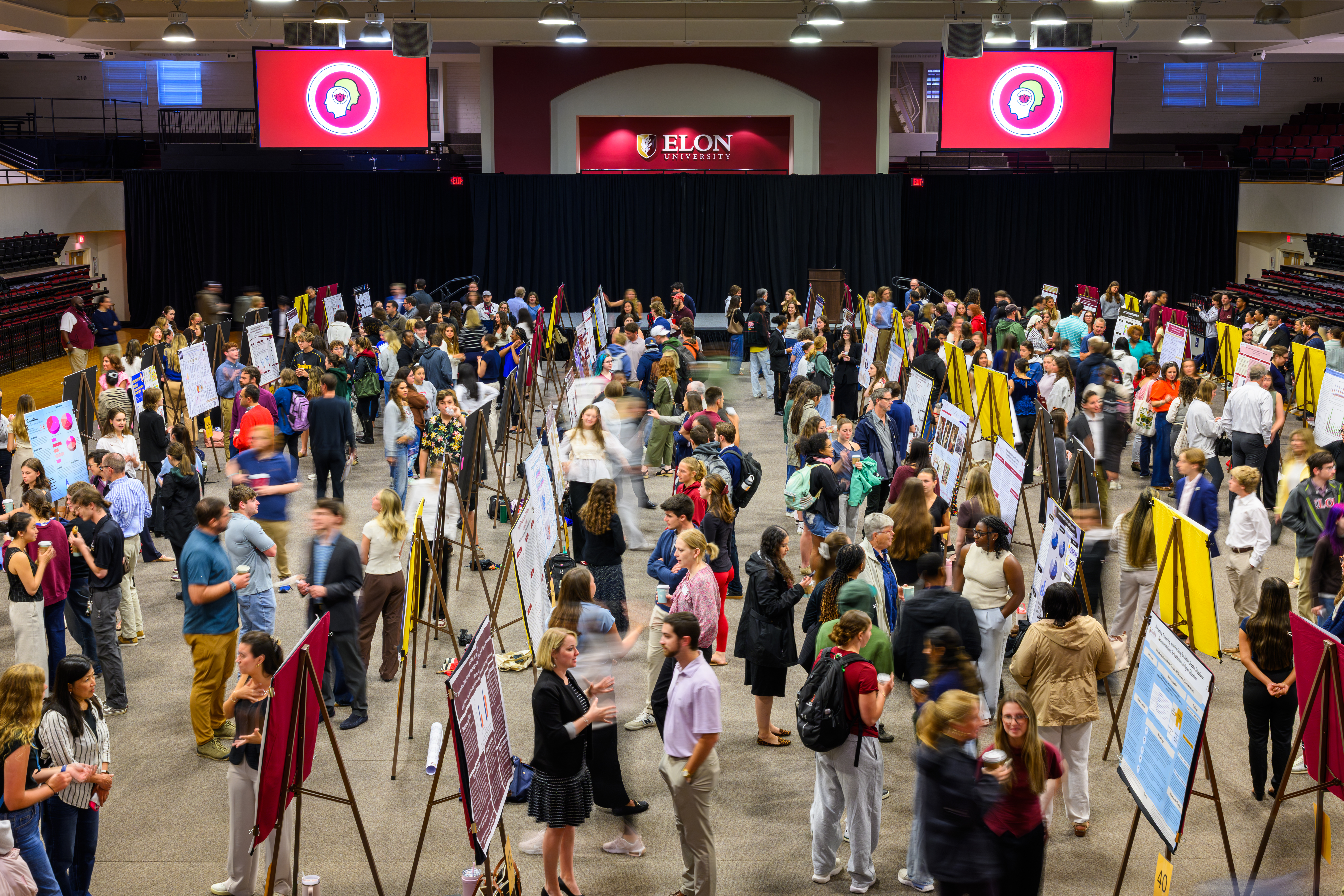
Elon University held its largest-ever Spring Undergraduate Research Forum on April 28, featuring 384 presentations, including 229 poster presentations, 155 oral presentations, and performances.
SURF Day is an annual event at the university, during which other campus activities are suspended to celebrate the academically centered creative endeavors and research efforts of Elon students. Undergraduate research is also one of the five Elon Experiences, which provides a natural extension of the work students do in the classroom and ensures that Elon graduates are prepared for both graduate school and careers.
“SURF continues to be the flagship event for undergraduate research on campus,” said Justin Clar, director of the undergraduate research program and associate professor of chemistry. “The record number of submissions is evidence of not only student involvement, but the work of dedicated mentors committed to preparing students for future success.”
Jen Hamel, associate director of undergraduate research and associate professor of biology, says putting together such a large event is a team effort.
“A lot of people work to make this day possible at Elon: our dedicated events and facilities staff, the Powell student workers, the faculty session moderators, abstract reviewers, and mentors and the Undergraduate Research team. And of course, the students work all year on their research and creative projects,” Hamel said.
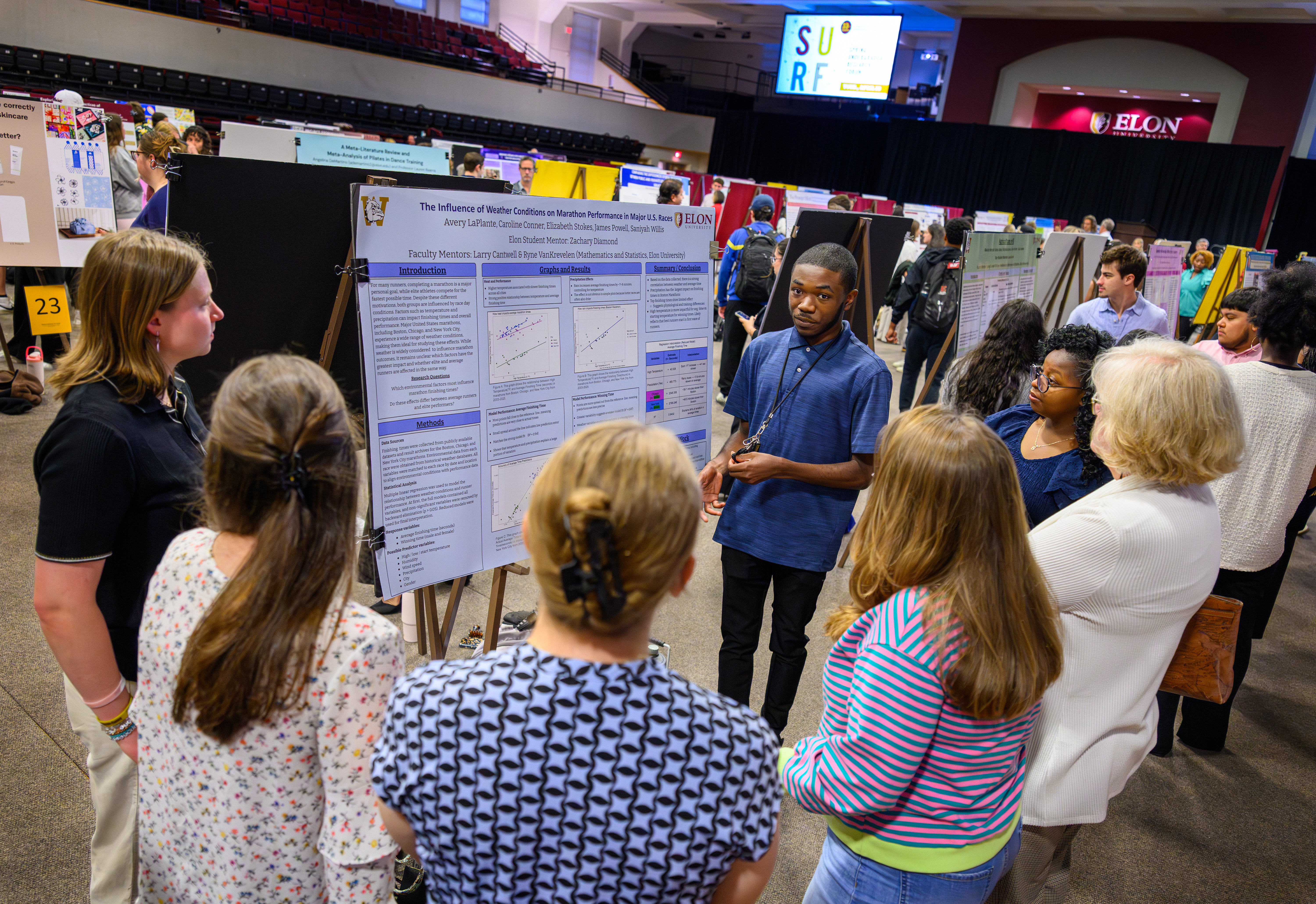
Throughout the day, students gave poster presentations in three sessions held in Alumni Gym, with oral presentations held throughout campus. Emily Stuart ’26, a professional writing and rhetoric major from Basking Ridge, New Jersey, was presenting for the first time at SURF. Her research focused on the perception of artificial intelligence integration in the digital marketing and communication workforce.
“I am a graduating senior, so I wanted to feel as prepared as possible for the workforce, and I do know that AI integration has become a major part of a lot of different fields,” Stuart said. “It felt like a really good way to tie it all together as part of my senior experience.”
Stuart did a literature review and sent out a survey to Elon alumni to get their perspectives. She found alumni discussed similar benefits to AI, including helping with productivity, but also expressed concerns over the environment, job loss and data privacy.
“This is my capstone research, I have spent a lot of time on it, and it does feel good to have people come up and want to learn about my research and being interested in it. It’s been a really cool way to end my semester,” she said.
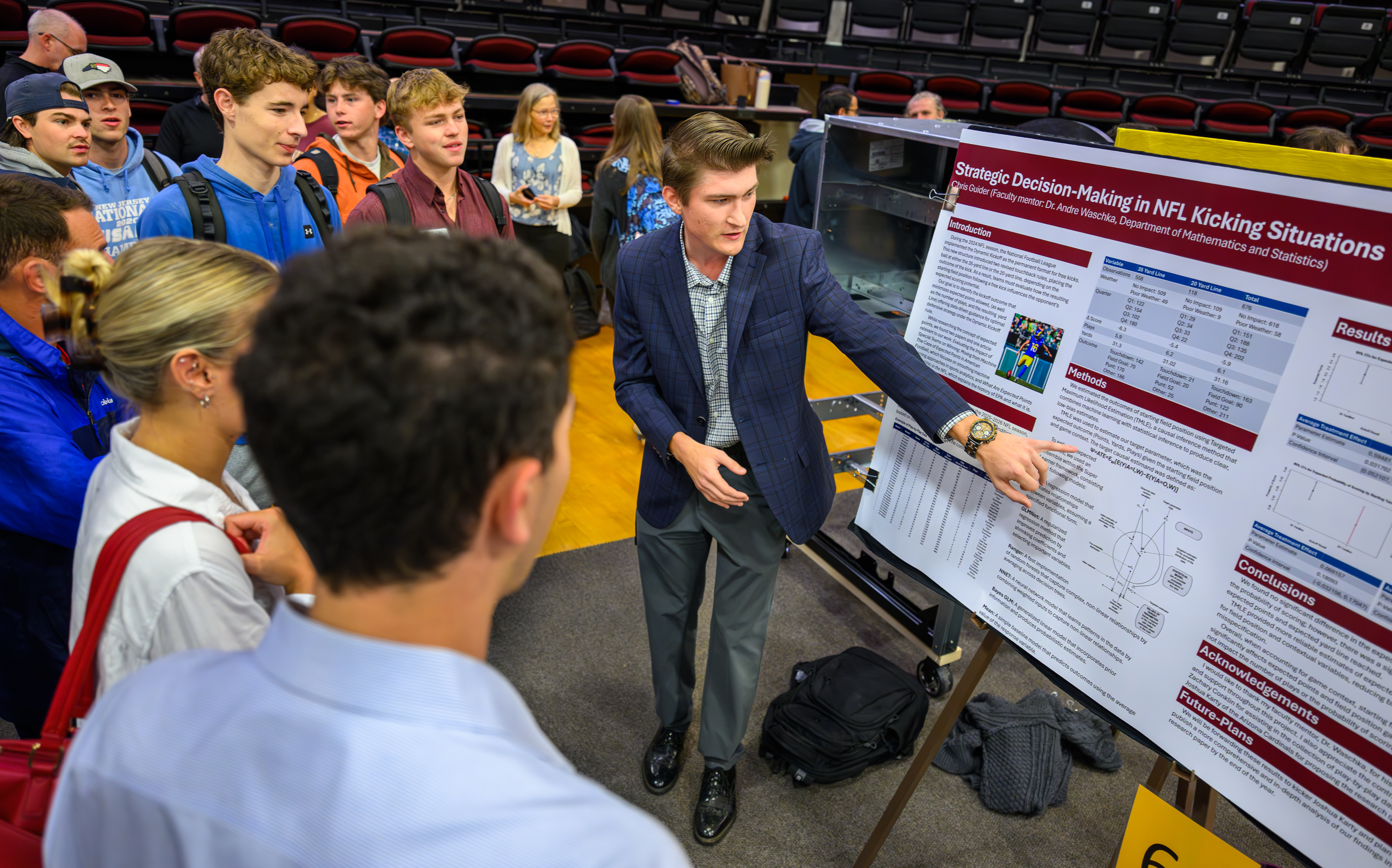
While Stuart is capping off her Elon career with SURF, Chris Guider ’29, a business analytics and economics double major from Holly Springs, North Carolina, is beginning his academic career at the annual event.
Guider’s project examines the effectiveness of the new NFL kickoff rules introduced in 2024. The changes, designed to improve player safety, created multiple “touchback” scenarios, situations where the ball is placed at different yard lines depending on how a kickoff ends.
“It’s rewarding because there are a lot of skills I’m learning, like coding in R or being able to interpret data,” he said. “It’s just reinforcing that I chose the right school because of the relationship I have with the professors I’ve been able to work with here.”
Students collaborate closely with faculty mentors throughout the research process—an aspect Abram Darby ’26, a psychology major, especially appreciated while working with his mentor, Adi Wiezel, assistant professor of psychology.
“She’s very motivated, enthusiastic and outgoing. It was easy to get involved in the project,” Darby said. “Our lab environment is great, too.”
Darby’s research examined how voters’ views on childcare policies might influence their preference for different types of political leaders—specifically, a knowledgeable female leader versus a more dominant and threatening male leader.
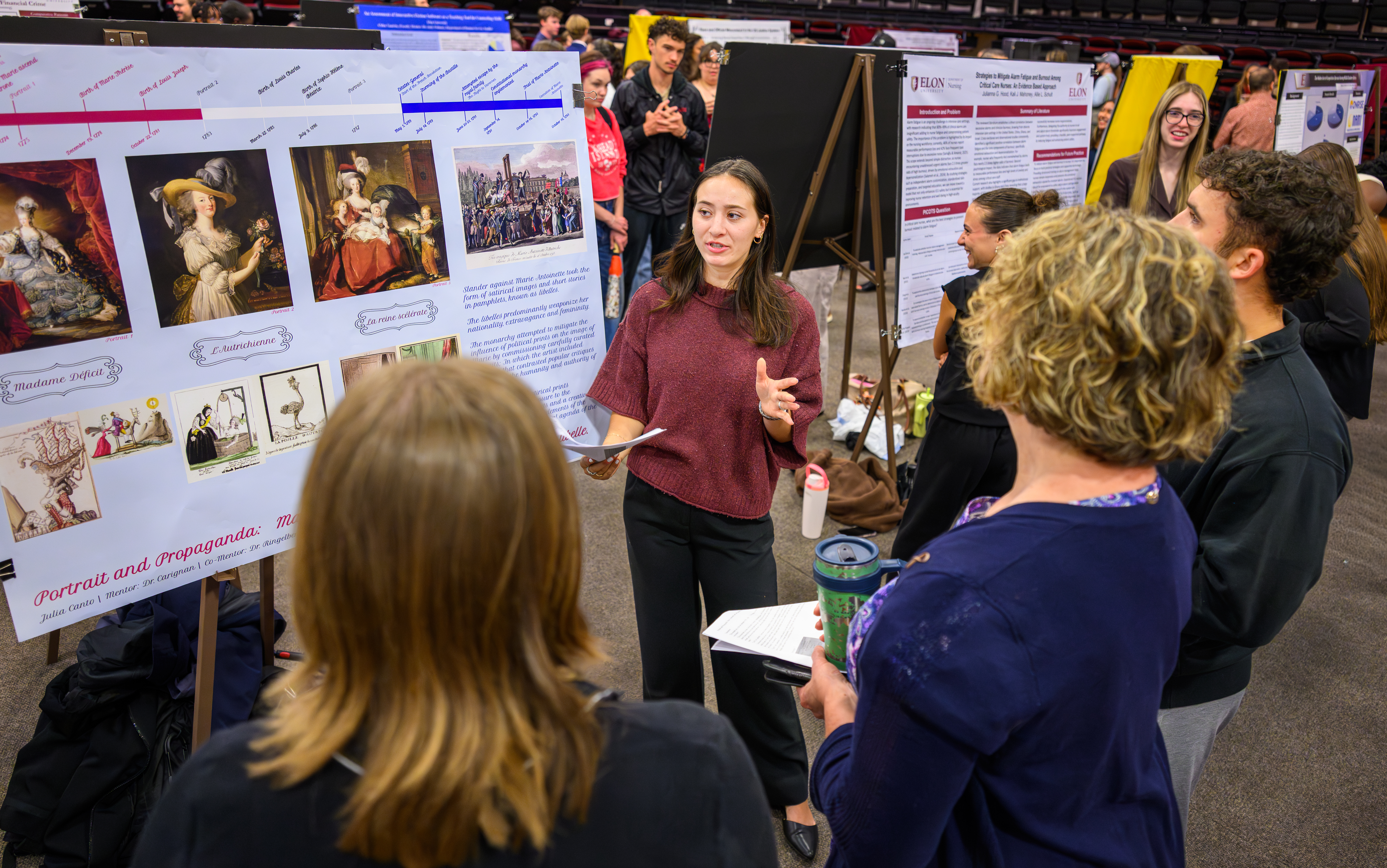
Initial pilot data suggested a connection, but it was based on the 2016 presidential election, when the Democratic candidate was a woman and Democrats were already associated with childcare policies. To explore the idea further, Darby selected an election in which a Republican female candidate defeated a male Democratic candidate. He removed party identifiers and asked participants which candidate they preferred, along with their reasons.
“What we found was among people who are motivated by childcare policies, when they perceive the female leader as being more prestigious than the male leader, they prefer them over the male leader significantly, suggesting that childcare policies may be a good proxy for who is going to win an election,” Darby said.
Catherine Dierker ’27, a history major with teaching licensure from Marietta, Georgia, also explored the political landscape, but in a different way. Her oral presentation focused on how educators can better prepare young people to participate in democracy. Her project examines effective practices in civics education, drawing from national and international data, teacher interviews and existing scholarship.
Mentored by Professor of Political Science and Public Policy Carrie Eaves, Dierker said the experience has been both academically rigorous and personally meaningful.
“She’s fantastic,” said Dierker of Eaves. “It’s those little connections that were nice to talk about and then really dive into the details of the research.”
In addition to SURF, students also have the opportunity to present research during the Summer Undergraduate Research Experience in June/July.
-
Justin Clar
Associate Professor of Chemistry and Director of Undergraduate Research Program
-
Carrie Eaves
Associate Professor of Political Science and Public Policy, Chair of the Department of Political Science and Public Policy
-
Adi Wiezel
Assistant Professor of Psychology
-
Jennifer Hamel
Professor of Biology