Wellness Centered Pedagogy
What We Mean by Wellness at Elon
At Elon, wellness is about much more than simply not being ill. It’s the proactive cultivation of a full, balanced life that embraces academic rigor, emotional resilience, social connection, and physical vitality. Wellness is a shared responsibility between students, faculty, and the broader campus community. It includes caring for ourselves and each other, and making space for reflection, connection, and growth.
This approach aligns with Elon’s HealthEU initiative, which promotes a culture of holistic well-being. When wellness is part of our teaching, we create classrooms where everyone can thrive.
Why well-being matters for learning?
Students today are navigating complex academic, social, and financial pressures. These stressors don’t just affect mental health, they directly shape students’ ability to focus, engage, and persist. When students feel emotionally safe, supported, and connected, they’re more likely to succeed.
Well-being in a pedagogical context goes beyond general wellness, it means intentionally designing learning environments that foster emotional and cognitive resilience. Practices like flexibility, inclusive design, and reflective activities aren’t just nice to have; they make learning possible. Research from the Center for the Study of Student Life at Ohio State University found that a strong sense of belonging is correlated with higher academic performance and retention (CSSL, 2020). Similarly, Felten & Lambert’s work in Relationship-Rich Education shows that when students feel genuinely cared for, their learning becomes more meaningful and enduring (Felten & Lambert, 2020).
Why well-being matters our teaching?
Teaching is emotionally and intellectually demanding, especially under the weight of high workloads, service commitments, and institutional pressures. Faculty who teach under chronic stress are more likely to experience burnout impacting both well-being and effectiveness in the classroom.
In this context, well-being isn’t just personal, it’s pedagogical. Wellness-centered teaching means designing and delivering courses in ways that are sustainable, relational, and inclusive. Trauma-informed strategies, inclusive course design, and reflective practices help faculty stay connected to their purpose and energy. Parker Palmer’s The Courage to Teach emphasizes the need for educators to align their inner lives with their teaching to sustain passion and connection (Palmer, 2007). Bell Hooks, in Teaching to Transgress, reminds us that engaged pedagogy must nurture both the mind and spirit of students and teachers alike (Hooks, 1994).
What Is Wellness-Centered Pedagogy?
Wellness-centered pedagogy is a research-informed, human-centered approach to teaching that weaves together well-being, equity, empathy, and flexibility. It invites us to think more intentionally about how we design our courses, connect with our students, and support ourselves as educators.
At its core, this approach recognizes that learning doesn’t happen in a vacuum. Students bring the whole person into the classroom along with stress, identities, relationships, and responsibilities. And so do we. Wellness-centered pedagogy asks us to meet those realities with care, not just content.
This isn’t about adding more to your plate. It’s not one more thing to do, it’s a different way of doing what you already do. That might mean applying universal design for learning (UDL) principles (CAST, 2018) to make your materials more accessible, or using trauma-informed practices (Carello & Butler, 2015) to build trust and predictability into your classroom structure. It might mean pausing for reflection, inviting students into meaningful dialogue, or being flexible when life inevitably shows up.
The framework is grounded in scholarship from culturally responsive teaching (Gay, 2010) and critical pedagogy (Freire, 1970) to relational and care-based teaching (Hooks, 1994; Noddings, 2005) and contemplative pedagogy (Zajonc, 2013). It also aligns with positive psychology models like PERMA (Seligman, 2011), which remind us that emotional well-being, meaning, and connection matter not just in life, but in learning too.
This model was developed by listening closely to what students and faculty were already saying through lived experience, classroom conversations, and faculty development workshops. It’s built around seven key pillars, each of which is:
- Clearly defined (What)
- Grounded in research (Why)
- Connected to real-world strategies (How)
When we approach teaching through this lens, we build learning environments that are not only inclusive and engaging but sustainable for everyone involved. This work helps us show up more fully, teach more meaningfully, and build classrooms where everyone feels like they belong.
Figure1. Wellness-Centered Pedagogy Framework
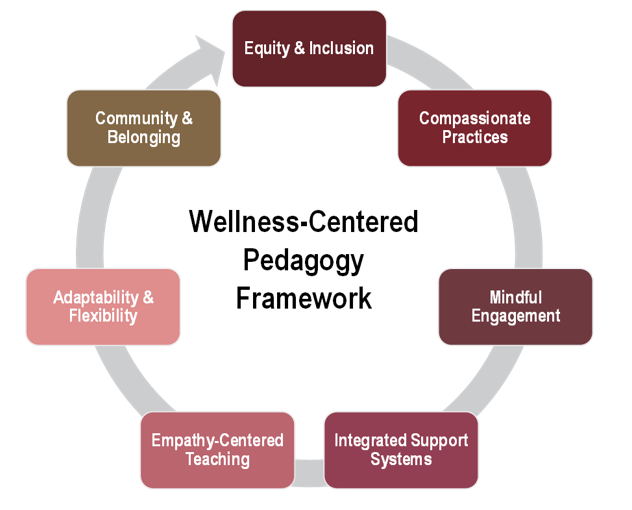
This page introduces the key pillars of a wellness-centered approach to teaching that prioritizes equity, empathy, flexibility, and whole-person learning.
Each pillar highlights:
- What it means
- Why it matters (theory)
- How to bring it into your classroom (practical strategies)
Learn more about each pillar below and read about actionable ideas and inspiration for creating more compassionate, inclusive, and resilient learning environments.
Equity & Inclusion
What: Create a learning space that values diverse perspectives, ensures accessibility, and promotes fairness. While general equity and inclusion practices are outlined on the Elon University CATL Equity & Inclusion page, here we focus on how these practices support student and faculty well-being.
Why: Designing for equity not only reduces barriers and honors diverse lived experiences but also fosters a deeper sense of safety, connection, and belonging. When students feel seen and supported, their mental, emotional, and academic well-being improves. Pedagogies like culturally responsive teaching, universal design for learning (UDL), and critical pedagogy help shift from a one-size-fits-all model to one where fairness and wellness are intentionally woven into the learning experience.
How:
- Use diverse, representative course materials
- Include accessibility and flexibility policies in your syllabus
- Encourage inclusive participation practices
- Start your course with a welcoming tone (in an intro video or course letter)
- Use transparent, affirming language in assignments and expectations
Compassionate Practices
What: Prioritize emotional safety, trust, and acknowledgment of student life realities while also recognizing that meaningful learning can sometimes be uncomfortable.
Why: When we lead with compassion, we normalize the realities of student (and faculty) life including stress, grief, caregiving, and burnout. This pillar draws on trauma-informed teaching, the pedagogy of care and self-compassion research to support classroom environments that feel safe, humane, and flexible. At the same time, we acknowledge that growth often involves challenges. Compassionate teaching doesn’t remove academic rigor but creates conditions where students feel supported enough to take risks, wrestle with discomfort, and stay engaged in the learning process.
How:
- Offer flexible attendance and participation
- Communicate with empathy
- Acknowledge personal and collective stressors
- Build in grace periods and flexible grading policies
- Make space for difficult questions and emotional responses as part of the learning journey
Mindful Engagement
What: Integrate mindfulness and reflection to support focus, emotion regulation, and deeper learning.
Why: Mindful engagement invites both students and faculty to slow down, be present, and connect more meaningfully with the learning process. Drawing on contemplative pedagogy and social-emotional learning, mindfulness supports well-being by helping build emotional regulation, cognitive clarity, and resilience. As Arthur Zajonc suggests in his work on contemplative practice, reflection isn’t a pause from learning—it’s a vital part of deep and sustainable learning.
How:
- Start or end class with a mindfulness pause
- Incorporate reflective journaling or check-ins
- Build in pause moments to process content
- Use intentional brain breaks during long sessions
Integrated Support Systems
What: Address the whole student including academic, emotional, social, and physical well-being.
Why: Students don’t learn in isolation. They carry stress, relationships, health concerns, and identities into the classroom with them. This pillar draws on PERMA and pedagogical wellness that call us to see students as whole people. By promoting support systems, we create spaces where students are more likely to succeed and faculty feel more empowered to help them.
How:
- Add wellness resources directly to your syllabus
- Offer mental health and wellness breaks in class
- Normalize and promote campus support services
Empathy-Centered Teaching
What: Prioritize relationships by seeing students as whole people with real lives, needs, and potential. When students know we care, they show up differently, and so do we. Empathy also reduces stress and fosters a greater sense of safety and well-being for both students and faculty.
Why: Empathy-centered teaching emphasizes connection, understanding, and authentic communication. Inspired by the work of Bell Hooks Teaching to Transgress and Parker Palmer’s The Courage to Teach (Courage & Renewal Approach), and relational pedagogy this approach reminds us that student success is deeply rooted in trust and relationship. When students know we care, they show up differently, and so do we. Empathy also reduces stress and fosters a greater sense of safety and well-being for both students and faculty.
How:
- Check in with students individually or as a group
- Offer growth-oriented and compassionate feedback
- Use anonymous midterm feedback to adjust in real time
Adaptability & Flexibility
What: Design with flexibility in mind to accommodate life’s unpredictability and student diversity.
Why: Adaptable teaching doesn’t lower standards, it raises support. Drawing from universal design for learning (UDL) flexible learning models, and the idea of compassionate rigor, this pillar acknowledges that students learn in different ways and under different circumstances. It supports mental and emotional well-being by reducing unnecessary stress and making learning more accessible, especially during times of uncertainty.
How:
- Offer flexible deadlines and extensions
- Provide materials in multiple formats
- Incorporate asynchronous participation tools
- Allow for resubmissions or learning recovery
Community & Belonging
What: Foster a classroom where students feel connected to each other, the material, and the world beyond.
Why: Belonging isn’t just a feeling, it’s a condition for learning. Grounded in experiential learning theory, collaborative pedagogy, and Bell Hooks’ work on community and hope, this pillar centers connection, relevance, and purpose. When students feel a sense of belonging, they’re more likely to engage, take academic risks, and persist. Belonging also supports mental health, motivation, and overall well-being, creating a foundation for both academic and personal growth.
How:
- Create space for peer mentorship or connection
- Facilitate group discussions that invite all voices
- Relate content to real-world and lived experiences
How to Engage with Wellness-Centered Pedagogy
Teaching is about more than delivering content, it’s about cultivating spaces where students and faculty can thrive. Below are several intentional pathways to explore, apply, and grow your practice through the lens of wellness-centered pedagogy.
1. Attend a Workshop
What you’ll experience:
Our workshops are designed to be reflective, practical, and community driven. Participants engage in structured dialogue, small-group collaboration, and activities that model wellness-centered strategies in real time. Workshops often explore topics like building inclusive classroom climates, trauma-informed syllabus design, and practices for supporting both student and faculty well-being.
How it helps:
These sessions offer a low-stakes, high-impact opportunity to explore teaching practices through a new lens. Faculty walk away with actionable tools including flexible policies, in-class activities and more that can be adapted to any discipline. You’ll also be part of a community of educators thinking intentionally about wellness in higher education.
2. Explore the Pedagogy
What you’ll find:
The wellness-centered pedagogy framework is built on key pillars such as Equity & Inclusion, Compassionate Practices, Mindful Engagement, Integrated Support Systems, Flexibility, and Community & Belonging. Each pillar is grounded in evidence-based pedagogical theory (e.g., Culturally Responsive Pedagogy, Universal Design for Learning, Contemplative Pedagogy, etc.) and offers a roadmap for practical integration into curriculum and classroom culture.
Check out the Wellness & Well-being at Elon LibGuide
How it helps:
By understanding the theory behind the practices, you gain clarity and confidence in your pedagogical choices. This approach moves beyond quick fixes or one-time adjustments, it invites you to align your teaching with values like empathy, equity, and well-being in sustainable, meaningful ways.
3. Join the Wellness Pedagogy Faculty Scholars Program
What you’ll experience:
This semester-long faculty development opportunity offers space, structure, and support to deeply engage with wellness pedagogy. Participants meet regularly for guided sessions, collaborate with interdisciplinary colleagues, and work on personalized deliverables such as a redesigned course, revised assessments, or a SoTL (Scholarship of Teaching & Learning) project focused on wellness.
How it helps:
The program offers a rare chance to step back and reflect on how your teaching aligns with your values and how it impacts student and faculty well-being. You’ll be supported in designing (or redesigning) course elements with intentional wellness touchpoints, such as inclusive policies, low-stakes assessments, and built-in reflection. Faculty also receive a stipend and join a supportive learning community that often continues long after the program ends.
4. Take a Self-Assessment
What you’ll reflect on:
This tool is designed to help you evaluate how your current teaching practices align with wellness-centered principles. It includes reflective prompts around course design, classroom culture, communication tone, flexibility, community building, and support systems. The goal is not perfection but awareness.
Try the Faculty Wellness-Centered Pedagogy Self-Assessment!
How it helps:
The self-assessment allows you to identify both strengths and opportunities for growth. It can also help guide your next steps, whether that’s rethinking your late policy, building more feedback loops with students, or carving out more space for your own well-being as an educator.
5. Schedule a Meeting with the Faculty Fellow
What you’ll receive:
This is a 1:1 conversation with the Faculty Fellow focused on your classroom, students, and goals. These meetings are collaborative and solution-focused. We’ll explore where wellness can be woven into your course in ways that support academic success and human flourishing.
How it helps:
Sometimes all it takes is a sounding board or fresh perspective to shift how a class feels for both students and faculty. These meetings are a space to brainstorm, reflect, or troubleshoot specific teaching challenges (e.g., disengagement, emotional fatigue, community-building). You’ll leave with tailored ideas and resources that align with your teaching style, values, and student needs.
6. Join the ThriveU Summer Program
What you’ll experience:
ThriveU is a summer faculty coaching program designed to support your growth, clarity, and well-being as a scholar, educator, and leader. Through structured reflection, one-on-one coaching, and peer dialogue, you’ll have the opportunity to step back, refocus your goals, and align your work with your values. Together, we’ll explore strategies for advancing your research agenda, navigating tenure and promotion, strengthening your leadership capacity, and sustaining a meaningful academic career.
How it helps:
Faculty life often requires juggling scholarship, teaching, service, and leadership all while trying to maintain your own well-being. ThriveU offers space to reset, gain perspective, and make intentional progress toward your professional and personal goals. Whether you’re mapping out your next publication, preparing for a leadership role, or simply seeking a more sustainable rhythm, this program offers individualized support, accountability, and encouragement grounded in your values and aspirations.
 For more information contact Dr. Anne-Marie Iselin (aiselin@elon.edu), Associate Professor of Psychology and Faculty Fellow on Wellness and Well-being