


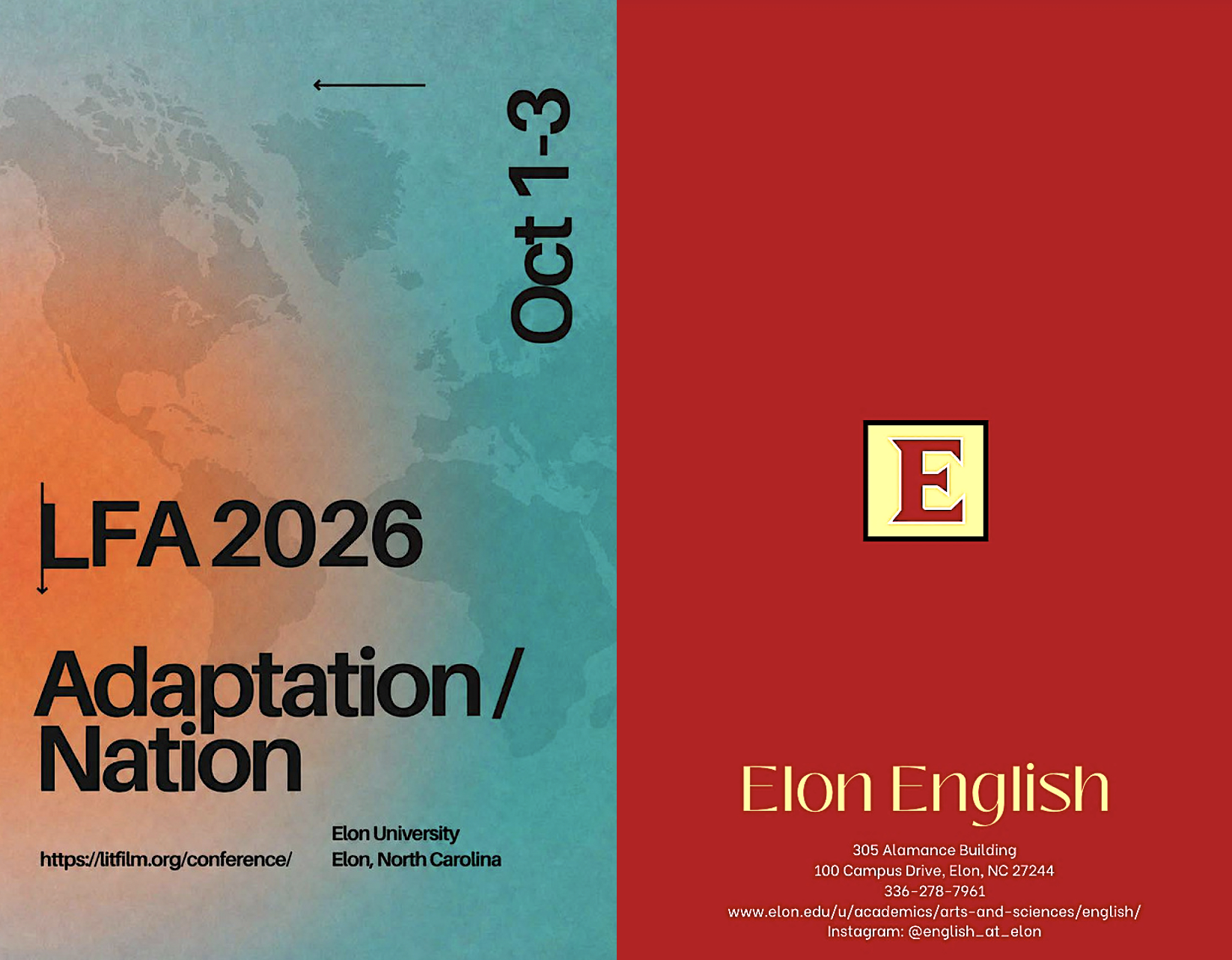
Centering on the theme of “Adaptation/Nation,” the three-day interdisciplinary conference featured the scholarship of 70 presenters from 45 North American institutions.
Elon University’s Department of English and global film & cultures Minor hosted the 2026 Literature/Film Association (LFA) Conference from Oct.1-3.
Currently the largest and most active scholarly society in the United States devoted to the study of adaptation, the LFA and its affiliated journal “Literature Film Quarterly” emphasize scholarship related not only to film and literature, but also to television, video games, new media and other forms of audio-visual culture.
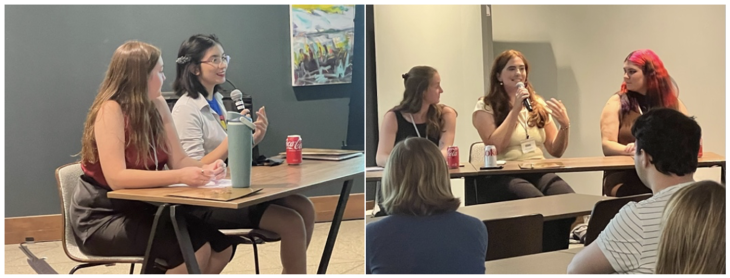
A panel of Elon College and Communications Fellows kicked off LFA 2026 with a session focusing on generic hybridity across a range of classic and contemporary U.S. science fiction, fantasy and horror texts. Ashley Hess’s paper on Jeff Vandermeer’s novel “Annihilation” and its film adaptation explored the theme of “architectural illegibility” at work in both texts, while Sophia Sta Rosa surveyed the cultural mythology of “Superman” as a uniquely nationalist franchise across multiple mediums and formats (comics, cinema and television). The panel concluded with Lealand Oakes, Alana Denby and Emma Briceño’s presentation “Don’t You Remember? Second-Hand Nostalgia as Co-Creation in The Duffer Brothers’ ‘Stranger Things’ and Andy Muscietti’s ‘It’ Duology” — an expanded version of their final research project for an adaptation course on the fiction of Stephen King.
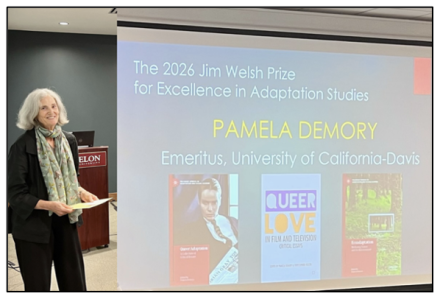
In collaboration with faculty member Sandy Marshall and the Global Neighborhood Film Series, Thursday’s conference programming continued with a screening of Todd Haynes’s 1950s-era lesbian melodrama “Carol” in honor of LGBTQ+ History Month. The film was introduced by Pamela Demory, lecturer emerita at the University of California-Davis and recipient of this year’s Jim Welsh Prize for Excellence in Adaptation Studies. Demory detailed Haynes’ adaptation strategies with respect to the film’s source, Patricia Highsmith’s novel “The Price of Salt,” and contextualized the director’s position within the New Queer Cinema movement of the 1990s. After the screening, Nikita Shepard of Elon’s Department of History & Geography provided historical background on the post-war surveillance of LGBTQ communities and moderated a lively Q&A between conference participants and attending students.
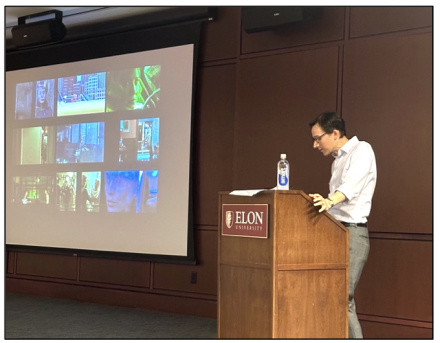
Friday’s keynote speaker, Rick Warner, delivered an excerpt from his forthcoming monograph “Patinas of the Moving Image,” an examination of the materialist aesthetic concept of “patina,” which Warner defined as “the historically sedimented look and feel of a film arising from the residual stamp or signature of media-technical formats and processes.” Filmic patinas, he went on to argue, adapt historically situated ways of seeing and feeling while variously sustaining, revising or contesting the nostalgic lenses through which nations imagine and scrutinize their pasts. Working through a range of examples including “Carol,” “Jackie,” “Ash Is Purest White” and “The Secret Agent,” Warner also asked the audience to consider what happens when the adaptive object is not a discrete text but a decade. In what ways, he queried, does the “felt character of an era make its way into a film’s materialized tones, textures, and atmospheres”?
Continuing this year’s conference theme of “Adaptation/Nation,” Saturday’s schedule included panels on subjects such as “New Cinemas and Internationality,” “National Ecologies,” “Resisting Racism” and a session devoted entirely to Paul Thomas Anderson’s recent counterculture epic “One Battle After Another.” Also featured among the panel presentations were two roundtables devoted to publication and pedagogy.
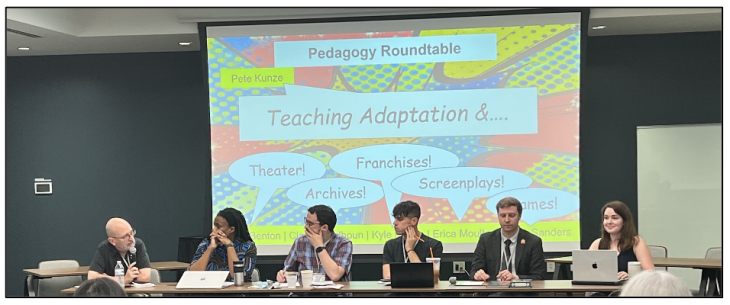
The 2026 Literature/Film Association Conference was supported by a variety of Elon programs and entities including the Dean’s Office in the School of Communications, the Dean’s Office in Elon College, the College of Arts & Sciences, Women’s, Gender, and Sexualities Studies, Latin American Studies, Peace & Conflict Studies, the Department of English, and the Global Film & Cultures minor.
Next year’s LFA Conference will be hosted at the University of Baltimore. A call for papers will appear on the association’s site in May 2027.
-
Dan Burns
Associate Professor of English
-
Lina Kuhn
Assistant Teaching Professor of English
-
Jeana Schickedantz
Program Assistant - English Department
-
Craig Morehead
Assistant Teaching Professor of English
-
Ben Murphy
Assistant Teaching Professor of English
-
Nikita Shepard
Assistant Professor of History
-
Sandy Marshall
Associate Professor of Geography