Climate
Elon University’s goal to become carbon neutral by 2037 is included in the Boldly Elon strategic plan (2020) and Sustainability Master Plan (2025). Calculating the university’s greenhouse gas (GHG) emissions (carbon footprint) is one of the essential steps in establishing a carbon neutral university. A yearly GHG inventory is conducted to monitor progress toward Elon’s emissions reduction goals.
Greenhouse Gas Inventory
The university’s first greenhouse gas (GHG) or carbon footprint was calculated for FY 2008, and it serves as the baseline from which to measure reductions. An inventory is conducted yearly to monitor progress toward the university’s carbon reduction goals. Elon’s FY 2025 net GHG emissions were 29% lower than FY 2008 net emissions. This decrease is mostly due to the source of Elon’s purchased electricity being less carbon intensive and the purchase of verified carbon offsets for the Carbon Neutral Global Engagement Initiative (CNGEI).
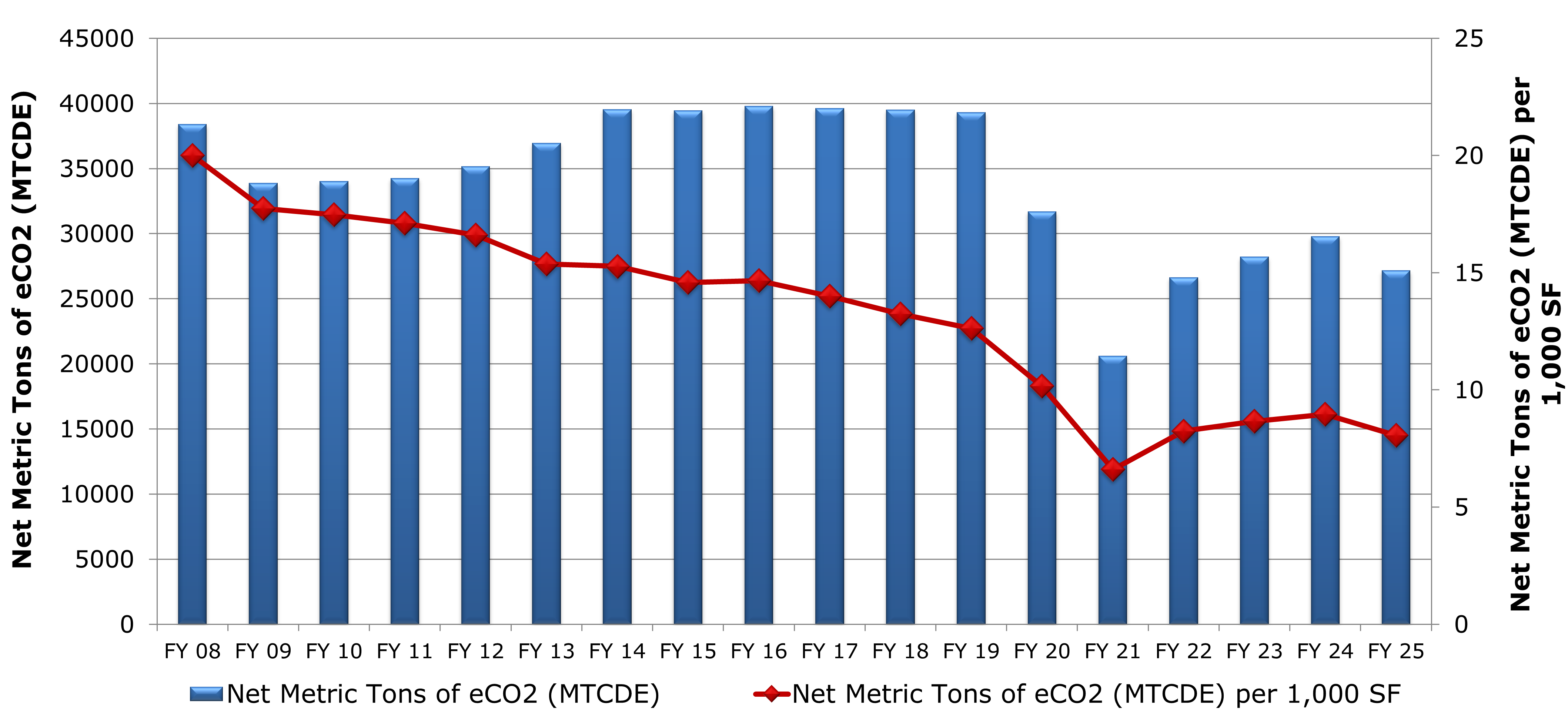
Emissions per 1,000 square feet decreased from FY 2008 to FY 2025, even though square footage increased 76%. This graph depicts the 60% decrease in emissions per 1,000 square feet (red line).
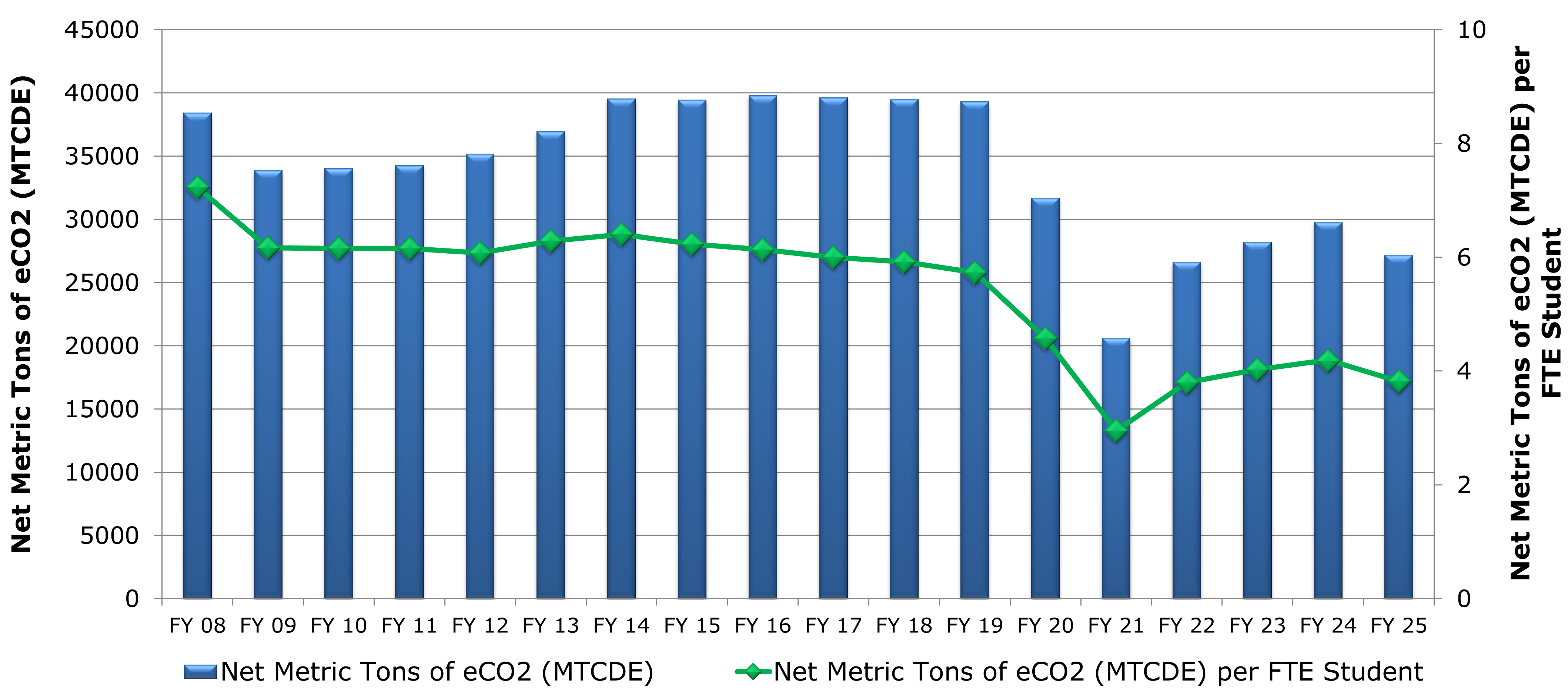
Emissions per student also decreased from FY 2008 to FY 2025, even though the number of FTE students increased 34%. This graph illustrates the change in emissions per FTE student over time. Compared to FY 2008, in FY 2025 emissions per FTE student were down 47% (green line).
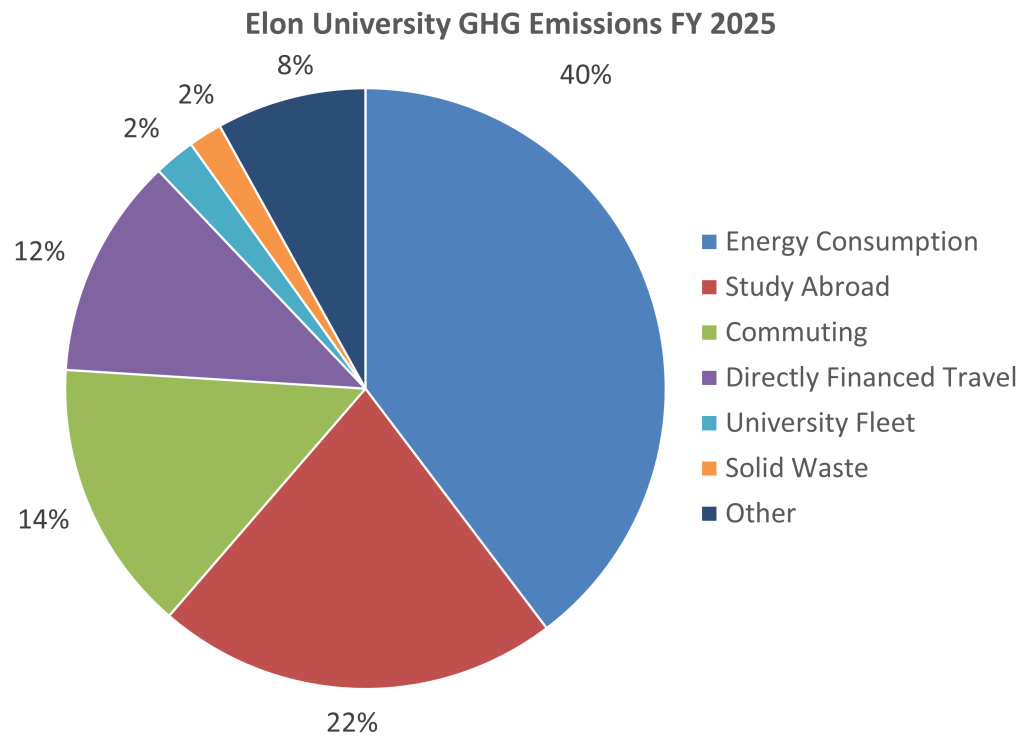
This chart illustrates the sources of Elon’s gross emissions (prior to subtracting verified carbon offsets). Energy consumption is the largest source of Elon’s GHG emissions accounting for about 40% of Elon’s emissions in FY 2025.
Study abroad travel represents about 22% of Elon’s FY 2025 emissions, which is a large increase from the 2% it was in FY 2021 due to the COVID-19 pandemic but not back to the 24% it was prior to the pandemic. Study abroad emissions are not a source of emissions that will be actively reduced. Given this, the Global Education Center (GEC) and Office of Sustainability collaborated to create the Carbon Neutral Global Engagement Initiative, which started in fall 2020. Through this initiative, Elon purchases verified carbon offsets on an annual basis to account for the carbon impact of global engagement travel.
Solar Farm at Elon
 The solar farm at Elon does not currently contribute directly to the university’s carbon reduction goals but it does contribute to regional carbon reduction.
Construction of the nearly 15 acre solar farm began in spring 2015 and was completed in October 2015. The system was designed for a maximum generation of 4,500 MWh of electricity, which equates to removing about 1,200 metric tons of carbon emissions per year from the atmosphere, based on Elon’s electricity supplier, or removing about 286 cars from the road per year. Real-time electricity generation can be viewed on the Building Dashboard.
The farm is on Elon property. The property is leased to Facile Solar LLC, a private company responsible for the operation of the facility. The electricity is sold through the owner of the facility to Duke Energy and delivered directly to the power grid where it, along with electricity from other sources, is utilized by regional customers.
The solar farm models responsible global citizenship and benefits Elon students by providing an opportunity to study the equipment, operation and economics of the system.
Visiting the Solar Farm
Request a Tour: One hour tour of the solar farm and Elon Environmental Center at Loy Farm which includes the responsible architecture studio, forest classroom and food and farming system operations. Minimum group size is 5 people. Parking is limited so transportation is provided to and from the Environmental Center.
Faculty interested in accessing the solar farm site for something other than a tour should contact Elaine Durr.