Suggestions for Teaching Writing with Generative AI
Teaching Writing as a Process with Generative AI as a Thought-Partner
These suggestions for teaching writing with AI are built upon and extend decades of research into best practices in writing instruction, which increase the likelihood that writing in the classroom encourages critical thinking, leads to engaged, deep learning, and discourages the misuse of AI. Each of these suggestions are explained in more detail below.
#1: Continue teaching writing as a process and using best practices in writing instruction
#2: Develop and clearly communicate generative AI expectations and guidelines for writing assignments
#3: Integrate AI into different part of the writing process as a thought-partner that supports critical thinking
#4: Teach students to critique the benefits and limitations of AI, to critique AI outputs, and to critically reflect on their AI use
#5: Attend to the equitable and inclusive use of generative AI in the writing process
#6: Research how generative AI might be changing your discipline and the professional writing of your alumni and consider adjusting the types of writing you assign accordingly
#8: Explore Other Elon AI programs and resources as well as statements and guidance from your own own discipline and profession
#1: Continue teaching writing as a process and using best practices in writing instruction
Decades of research into best practices in writing instruction remain relevant and should continue to be central to your writing pedagogy. Focusing on writing as a process (and not only as a final product), scaffolding writing assignments, and integrating best practices not only support students in learning content and developing as writers, but they also discourage the misuse of generative AI. Continue to integrate best practices into your writing pedagogy by:
- Designing meaningful writing assignments with specific audiences, purposes, and rhetorical situations and that encourage learning content and developing specific writing skills
- Focusing on writing as a process by building in, for longer assignments, brainstorming, researching, writing multiple drafts, peer-response, and revising; focusing on writing
- Asking students to write in a range of genres, especially those connected to specific disciplines
- Incorporating different ways of writing into your classes, including informal, low-stakes writing; reflective writing; longer, high-stakes writing; and multimedia writing
- Consider engaged learning pedagogies that ask students to write in authentic contexts and for real audiences, such as problem-based learning, project-based learning, and wicked-problems.
#2: Develop and clearly communicate generative AI expectations and guidelines for writing assignments
- Be transparent with students about your writing assignment expectations about the use of generative AI.
- Add a clear “Acceptable Generative AI Use” statement to your syllabus and to individual writing assignments. Many example statements can be found online. This “AI Syllabus Language” heuristic helps you think through the stance you’d like to take with AI in your policy and provides a heuristic for developing your own AI Policy.
- You might have a generic statement for your syllabus, and then more detailed statements for each of your writing assignments. Or you might have one detailed statement for your syllabus that you repeat for each writing assignment.
- Your “Acceptable Generative AI Use” statement might be different for different writing assignments.
- Your “Acceptable Generative AI Use” statement might range from never permitting the use of AI to permitting it in specific instances. For example class policies for classes across the curriculum and heuristics that can help you create your own policy, see “Classroom Policies for AI Generative Tools” and “AI Syllabus Language Heuristic.”
- Explain your “Acceptable Generative AI Use” statement to your students and how it will apply to the writing assignment.
- Explain the consequences if a student violates your “Acceptable Generative AI Use” policy.
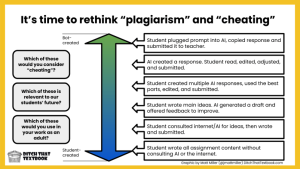
- Consider your stance, and your discipline’s approach, toward plagiarism and generative AI when developing your “Acceptable Generative AI Use Policy.” As this infographic asks, “Which of these you consider ‘cheating’? Which of these is relevant to our students’’ future? Which of these would you use in your work as an adult?” (Ditch that Textbook)
#3: Integrate AI into different part of the writing process as a thought-partner that supports critical thinking
Writing technologies are always changing, which in turn alter how we write. In the suggestions below, students are encouraged to use disciplinary knowledge and critical thinking throughout their writing process and about their writing situation in order to use generative AI effectively. Each suggestion also requires students to consider how their prompt elicits different outputs (i.e., they engage “prompt engineering,” which is a kind of critical thinking), to critically evaluate AI output, and to engage in the “human-AI loop” (refining their prompts to ask additional questions). Here are some examples of how students can interact with AI as a thought-partner throughout the writing process, to support–and not replace–their critical thinking:
AI & Brainstorming
Use AI to expand the possibilities for thinking—to generate perspectives, questions, connections, and potential audience responses—but not to determine which ideas are worth pursuing. The writer’s intellectual work is to question, evaluate, connect, and make decisions about what emerges from the brainstorming process.
- Explore a topic from multiple perspectives (economic, historical, feminist, Marxist, environmental, ethical, political, cultural, scientific, legal, psychological, sociological, technological, or rhetorical), then compare and critique what each perspective reveals or overlooks.
- Investigate an audience. Ask AI to help identify an audience’s possible needs, values, prior knowledge, attitudes, and concerns. Then evaluate the output: is it well-supported? unsupported? over-generalized? stereotyped?
- Use scholarship to generate new questions. Provide AI with several sources and ask it to identify unanswered questions, competing claims, or possible connections. Return to the original scholarship to determine whether those observations are supported and which you might want to pursue.
- Use AI to simulate a conversation. Ask AI to respond from a defined perspective—such as a skeptical stakeholder, disciplinary expert, potential client, or member of an intended audience. Use the exchange to test ideas and uncover questions or counterarguments, while recognizing that AI is simulating a perspective.
AI & Researching
AI can help generate questions, connections, and search strategies, but students should locate authoritative scholarship, read the original sources, verify AI-generated claims, and make the final decisions about relevance, credibility, and meaning.
- Refine a research question. Use AI to generate alternative versions of a question by narrowing or broadening its scope, changing the population or context, or introducing a different perspective. Evaluate which version best fits the purpose, audience, genre, and scope of your writing situation.
- Engage more deeply with scholarly sources. Share scholarship and ask AI to summarize arguments, identify key concepts, or explain difficult passages. Return to the original sources to verify and evaluate the AI’s output.
- Compare and synthesize sources. Ask AI to help identify relationships among sources—for example, similarities and differences in arguments, methods, evidence, populations, findings, or theoretical approaches. Evaluate those the output against the original scholarship before using them.
AI & Drafting
AI can generate possibilities, but students should make rhetorical decisions about ideas, evidence, organization, argument, audience, and language. The goal is not simply to produce a stronger text, but to use drafting as a process for developing the writer’s thinking.
- Explore different ways to organize. Ask AI to generate several possible ways to organize a draft for a particular audience, purpose, and genre. Compare the options, identify their strengths and limitations, and develop your own structure.
- Test rhetorical choices. Ask how different choices about content, organization, evidence, or style might affect a particular audience. Use the output to make—and justify—your own drafting decisions.
- Experiment with different approaches. Ask AI to demonstrate several possible ways of approaching a section—for example, beginning with evidence versus context, foregrounding different claims, or addressing different audiences.
- Evaluate the alternatives before drafting your own version.
Use AI as a responsive reader during drafting. Share a developing section along with the intended audience, purpose, and genre, and ask what questions a reader might have, where more explanation or evidence may be needed, or what ideas seem most important to develop further.
AI & Revising
Students already receive feedback from peers, Writing Center consultants, and faculty. AI can provide another source of feedback—but the writer remains the decision-maker.
- Ask for targeted feedback: Rather than “How can I improve this?” explain your rhetorical situation and writing goals and ask AI to respond to specific concerns.
- Content: What ideas need more development? Where might a reader need additional context, explanation, or evidence?
- Argument & Evidence: Which claims seem well supported? Where might a reader question the reasoning or want additional evidence? Identify possible counterarguments I should consider.
- Organization: Given my audience, purpose, and genre, where does the organization help or hinder the reader?
- Clarity: Identify passages a reader might find difficult to follow and explain why they may be unclear—without rewriting them for me.
- Style & Tone: Given this audience, purpose, and genre, where does my style or tone support my rhetorical goals, and where might it work against them?
- Compare sources of feedback. Compare AI feedback with feedback from peers, faculty, or Writing Center consultants. Where do they agree or disagree? Make deliberate revising rhetorical choices.
AI & Editing
Once substantive revision is complete, AI can serve as an editing assistant—but the writer remains responsible for the final text.
- Grammar, spelling & punctuation: Ask AI to identify potential errors and explain suggested corrections rather than automatically rewriting the text.
- Clarity & concision: Ask AI to flag sentences that may be unclear, wordy, repetitive, or difficult to follow. Evaluate the suggestions and make your own edits.
- Style & voice: Ask AI to identify patterns in sentence structure, word choice, transitions, passive voice, or tone that may not fit your intended audience, purpose, or genre.
- Consistency: Use AI to identify inconsistencies in terminology, tense, formatting, capitalization, tone, or other stylistic choices across a longer document.
- Citations & formatting: Ask AI to help identify possible formatting problems or demonstrate how a citation might be formatted in a particular style. Verify all citations against the original sources and the appropriate style guide.
#4: Teach students to critique the benefits and limitations of AI, to critique AI outputs, and to critically reflect on their AI use
- Teach students to use it critically, ethically, and responsibly, just like with other writing technologies (Wikipedia, search engines, Word autocorrect, etc.).
- Discuss how AI outputs should never be used entirely as they are and without revision, but rather as starting points in the Human-AI Loop (content is created not just by the AI statistical probability, or just by a human, but rather by a human revising AI outputs given the rhetorical situation)
- Experiment and practice using the AIs together as a class as part of the writing process
- Critique the generative AI outputs together as a class. For example, in what ways is the output effective or ineffective? appropriate in content, style, or form? appeals to or fails to appeal to a specific audience?
- Critique the benefits and limitations of using generative AI in the writing process
- Ask students to write a reflection when they’ve used generative AI for writing assignments. For example, which AI did they use? in what ways were the outputs effective, ineffective? how did they revise the output (the Human-AI Loop)?
- Ask students to submit the transcripts created while using generative AI
#5: Attend to the equitable and inclusive use of generative AI in the writing process
If you choose to integrate generative AI into your writing pedagogy, ensure that students have equal access to the technology and to training and support. If you are using an AI that requires a subscription, include the cost in your syllabus and arrange for ways for students to access the technology if the cost is prohibitive, or commit to using only free AIs. Explore how different AIs (like text-to-speech or speech-to-text) might enhance the writing process for students with different needs.
#6: Research how generative AI might be changing your discipline and the professional writing of your alumni and consider adjusting the types of writing you assign accordingly
We know that some professions have been integrating generative AI into their writing process for a while, and there is much speculation about how generative AI might alter professions and lead to lob loss (for example, see “AI is on a collision course with white-collar, high-paid jobs-and with unknown impact”). Talking with students who’ve done internships and alumni from your programs can help us understand how their professional writing lives might be impacted by generative AI. Consider applying for a CWE “Elon Alumni Who Write Grant,” which will award you $300 for inviting alumni to speak on campus (in-person or zoom) about their professional lives, including the kinds of writing they do at work and the extent to which they might be using generative AI. Consider teaching how professionals use AI somewhere in your curriculum.
Some example professions that have been using generative AI include: journalism, marketing and advertising, finance and banking, data science, software development, accounting, professional writing and editing, law, education, customer services, scriptwriting, real estate, healthcare, and social media.
#8: Explore other Elon AI programs and resources as well as statements and guidance from your own own discipline and profession
For example, CATL and the AI Hub at Elon offer some AI support and resources.