2024-2025 Inclusive Excellence Report
(Based on the objectives established in the School of Communications Diversity, Equity and Inclusion Plan, which guides our inclusive excellence goals and efforts since AY 2023-2024).
Prepared by: Professor Vanessa Bravo
This report includes the following content:
- The most-recent School of Communications Diversity, Equity and Inclusion Plan (from now on, SoC DEI Plan, in place since academic year 2023-2024), linked here.
- A section with the School of Communications (SoC) inclusive excellence outcomes for the 2024-2025 academic year, based on the main areas presented in the SoC DEI Plan:
– Inclusive Curriculum
– Student Recruitment & Retention
– Diverse & Culturally Proficient Faculty
– Inclusive Climate
– Communications - An Appendix section with the school’s 2024-2025 Inclusive Excellence Faculty Activity Report.
School of Communications Inclusive Excellence Outcomes for the 2024-2025 Academic Year
The current SOC DEI Plan, approved by the faculty in AY 2023-2024, continues to guide the school’s goals and efforts for AY 2024-2025. The following report details the inclusive excellence outcomes achieved in this academic year.
Inclusive Curriculum
The School of Communications intentionally infuses content that is centered on inclusive excellence in its curricular offering through required and elective courses, experiential learning opportunities for its students, diverse guest speakers and classroom activities, as described next.
Course objectives and course curricula
The SoC has inclusive excellence-related objectives in required courses (as shown below) but it also developed a dedicated, required class, focused on inclusive excellence: COM 2000 Inclusive Communications. The description and student learning outcomes (course objectives) of this course are the following:
COM2000 Inclusive Communications
Course Description:
- “This course is an introduction to foundational social and theoretical communication concepts related to diversity, equity and inclusion. You will practice interpersonal, small group, and written communication skills essential for advocating, participating, and leading in today’s global workplaces. Students will explore how mass media and social media helps construct notions of social reality, with a focus on media representations of marginalized groups in the United States and globally.”
Goal:
- “To equip students with knowledge and skills to advocate for and understand the value of diversity, equity and inclusion.”
Student Learning Outcomes:
- develop awareness and appreciation for diverse peoples and cultures.
- explain the concepts of diversity, equity, and inclusion in collaborating with and advocating for diverse and inclusive teams.
- recognize the validity of differing perspectives in ethical reasoning and decision-making.
- consider issues of identity within the context of media, including stereotypes, ownership, power, and audience perception.
- demonstrate culturally proficient communication in writing and speaking to and about diverse global audiences.
AER-Approved courses at the SoC
In 2024-2025 the SoC developed a new elective course that fulfills the Advancing Equity Requirement (AER) of Elon University. Developed by assistant professor Karen Lindsey, the 4-credit class, STC 3710 Strategic Communications and Social Change, will be offered for the first time in the Fall of 2025. Dr. Linsey will teach this class. As of July of 2025, there were 28 students registered for the class (which is capped at 33 students). The description and objectives for the class are the following:
Description:
The course explores how strategic communications is used in advocating for, shaping, and influencing social change in the United States. Specifically, the course addresses how communication through advertising, television, cinema, journalism, corporate communications, and sports have been essential in the quest for social change. The course examines historic and contemporary social justice movements, explores systemic power in communication disciplines, and analyzes outcomes of various movements that spurred change in the United States. Case studies in this course will be refreshed as contemporary issues and relevant topics emerge in the field of communications and in society.
Student Learning Outcomes
- Students will evaluate the historic, cultural, and societal causes of structural racism and how mass media and social media have used activism and advocacy to communicate about social movements.
- Students will interrogate their positionality as they consider their various forms of communication consumption, engagement, and influence in social movements.
- Students will explain how racial inequities are interwoven in US systems including media coverage of education, government, policing, healthcare, and how the media perpetuates or dismantles inequalities.
- Students will apply real and/or theoretical solutions to create a discipline-based project focused on advocacy on behalf of a group with intersectional identities or social cause that addresses inequality.
Additional courses in the SoC that fulfill Elon University’s AER requirement are Associate Professor Jane O’Boyle’s section of COM 4970 Great Ideas in Communications and Assistant Professor of Teaching Stacy Saltz’s section of the course CTA 4975 Entertainment Media: Issues and Research.
Other SoC Required Courses with inclusive excellence objectives
Other required courses in each of the SoC majors and in the SoC’s Core Curriculum that include inclusive excellence-focused student learning outcomes (course objectives) are the following:
In the COM Core Curriculum:
COM 1000 Communications in a Global Age
- identify significant milestones and individuals in the multicultural history of communications.
- define “audience” and describe examples of media content tailored to reach diverse domestic and global audiences.
COM 4970 Great Ideas in Communications: Issues & Research (capstone for MEA & STC)
Two of the five issues that students can choose to focus on in class discussions and to write a research paper include the following two:
- Audience and Consumption
- Power, Knowledge and Diversity
In Cinema and Television Arts (CTA)
CTA 2100 Introduction to Cinema and Television Arts
- reflect on how cinema & television are tools of communication and can facilitate the understanding of domestic, global and diverse cultures.
- write and speak clearly and effectively to critically evaluate one’s own viewing habits, preferred genres, and biases.
CTA 3260 Cinema Production
- understand and incorporate best practices of diversity, equity and inclusion including an emphasis on supportive and equitable working environments.
CTA 3240 Studio Variety Reality TV Production
- understand and incorporate best practices of diversity, equity and inclusion on set and in creative works
CTA 4550 Advanced Documentary and Non-Fiction Production
- critique content for aesthetic value while considering diverse domestic and global audiences.
- understand and incorporate best practices of diversity, equity, and inclusion, including an emphasis on supportive and equitable working environments.
CTA 4550 Advanced Narrative Production
- critique content for aesthetic value while considering diverse domestic and global audiences.
- understand and incorporate best practices of diversity, equity, and inclusion, including an emphasis on supportive and equitable working environments.
CTA 4974 Entertainment Media Issues and Research
Course Description:
- “In this senior level course, students use sound research methodologies to offer solutions to contemporary issues related to systemic racism and other inequities through the lens of the entertainment industry. To accomplish this goal, students will examine scholarship focused on race, intersectionality, media representations, onset production cultures, content distribution, and exhibition. Students will gain an understanding of how equitable practices in the industry can influence the success of media production and consumption. In addition, students will learn how entertainment content can serve as an educative tool for media consumers. Senior Standing Required
Student Learning Outcomes:
- use clear and effective writing to assess the relationship between your racial and other identities and the entertainment industry both as a consumer and as a professional.
- conduct historiography and case study research to assess the structures and systems that shaped the multicultural history and roles of media in society.
- apply qualitative and quantitative research methods to assess diverse representations in front of and behind the screen
- examine how images in the entertainment industry reflect issues related to the state of race and racism in the US
- assess content or textual analysis to understand current trends in the depiction of race and intersectional identities in current entertainment content
- recommend or advocate for racial and intersectional equity in entertainment media organizations and/or teams in a well sourced paper or project.
In Communication Design (CDE)
CDE 2580 Principles of Communication Design
- Consider how visual components influence the perception of media messages and impact diverse domestic and global populations.
- Describe how issues relevant to freedom of expression and ethical ways of reasoning influence the practice of visual communications.
CDE 4580 Design Strategies and Solutions
- Use advanced design theories and methodologies to produce professional-quality content that targets a specific audience.
- Engage in advanced levels of research and analysis to deliver professional-level solutions to clients, key stakeholders, and specific, targeted audiences.
In Journalism (JOU)
JOU 1100 News Writing and Reporting
- gather information from diverse sources and critically evaluate the credibility of sources.
- further develop awareness of ethical ways of reasoning and professional writing standards in matters such as truth, accuracy, fairness, objectivity, diversity and meeting deadlines.
- compare and contrast writing for different audiences, different media and across multimedia platforms.
JOU 2500 Journalism in a Free Society
- explain the contributions of domestic and global diversity to the evolution of journalistic practice.
- evaluate reporting on race and intersectional identity, as well as historical, cultural, and societal causes of systemic and structural inequity.
JOU 3100 Reporting for the Public Good (elective course, not included in the grid)
- further develop awareness of ethical ways of reasoning and professional writing standards in matters such as truth, accuracy, fairness, inclusive excellence, and timeliness.
- write clearly, accurately, and effectively, and with a sense of serving the public good. This includes serving a wide range of people across our society and being alert and committed to issues of free expression, social justice, and equity.
- reflect on and articulate the community-building function of news, and your place in it.
JOU 3150 Digital News Production
- assess how technology in news can affect diverse groups, such as sampling issues with social media, effect of lighting on skin tones, algorithmic bias, and disability access.
JOU 4500 Multimedia Journalism (elective course, not included in the grid)
- engage in ethical ways of thinking and apply professional standards, such as truth, fairness, accuracy and attention to diversity of audiences.
JOU 4970 Investigative Journalism
- plan and produce multimedia reporting projects using data, diverse sources, public records, and the tools of technology
- review the history and roles of investigative reporting in journalism, comparing the levels of diversity in historic news reporting with modern reporting.
In Media Analytics (MEA)
JOU 1100 News Writing and Reporting
- (see SLOs listed above, under “In Journalism”)
MEA 2600 Understanding Audiences
- explain demographic and psychographic variables that are traditionally used to describe media audiences.
- explain strategies used by the creators of media messages to appeal to large and specialized audiences, including diverse domestic and global populations.
MEA 3190 Communicating Media Insights
- interpret complex media analytics to provide insights and make recommendations to guide informed decisions for communicating with diverse domestic and global audiences
In Strategic Communications (STC)
JOU 1100 News Writing and Reporting
- (see SLOs listed above, under “In Journalism”)
STC 2520 Foundations of Strategic Communications
- understand issues of diversity, equity and inclusion (DEI) in the United States, historically and currently, and their impact in the practice of the strategic communications professions today.
- demonstrate an awareness of domestic and global diversity with internal and external audiences.
- recognize the impact that lack of diversity in strategic communications and within working teams can have in the real world, including reputation damage, crises and financial losses.
STC 3120 Strategic Writing
- demonstrate writing and presentation techniques that pertain to diverse domestic and global audiences, media and messages.
- create culturally appropriate content targeted to different communities/groups, according to their information needs, that considers DEI.
STC 3620 Strategic Research Methods
- understand the impact of DEI (or lack thereof) in the research process, and apply this understanding to research ethics, design, instrument selection, data-collection, analysis and synthesis of results, and production of written and oral reports
STC 4520 Strategic Campaigns
- demonstrate cultural proficiency and awareness about diversity, equity, and inclusion in the preparation of strategic campaign materials.
- understand the value of working with diverse teams and of advocating for diverse teams in your profession to develop strategic campaigns.
- articulate the business case for incorporating DEI in the strategic communications and within the teams that develop those communications, in the U.S. context and internationally.
Finally, it is relevant to mention that the SoC oversees two interdisciplinary minors where inclusive excellence goals and objectives are also included in the course offerings: the Global Film and Cultures minor and the Health Communications minor.
School of Communications Experiential Learning Opportunities
Some of the experiential learning opportunities that the School of Communications students had in 2024-2025 were the following:
Study abroad:
In January 2025, the following SoC faculty led or co-led study abroad courses:
- Dr. Rich Landesberg and assistant professor Max Negin led the Holocaust Journey study abroad; Dr. Alex Luchsinger and Dr. Khirey Walker co-taught a course on sports and ESPN in Argentina;
- Mark Cryan co-led a course about baseball in the Dominican Republic;
- Dr. Vanessa Bravo co-led a study abroad class in Costa Rica;
- Dr. Young Do Kim taught the course Business, Culture, and Economics in East Asia, which explored the transformation of East Asia: South Korea and Japan.
Study away:
- Assistant Professor Kai Swanson led a study away course to the Sundance Film Festival and to Los Angeles.
Undergraduate research:
Students conducted undergraduate research that involved issues connected to inclusive excellence in many ways, from research projects in the course COM 4970 Great Ideas in Communications to mentored research experiences with individual faculty members.
There are too many examples to list them all, but some that resulted in conference presentation, refereed exhibition, selection for external awards, or peer-reviewed publication were the following:
Published in the Elon Journal
Spring 2025
- Model Queerness: Intersectionality Within the Representation of Mainstream Queer Film Post-Obergefell v. Hodges, by Mackenzie Smith ’25.
Fall 2024
- Constructing the Online Self: Examining the Extent and Reasoning Behind Self-Presentation on Social Media, by Jessie Cordwell ’25.
- Antes del sol (Before the Sun): Bridging Acculturation Gaps in Hispanic and Latin American Immigrant Families with a Dual-Language Board Game, by Matt Newberry ’24.
- Trusting Tracking: Examining Black Women’s Perceptions of Menstrual Cycle Tracking Applications in a post-Roe v. Wade World, by Naomi Washington ’24.
Presented at AEJMC’s Southeast Colloquium (March of 2025, at UNC Chapel Hill)
- A Special Interest in Spontaneity? Newsroom Experiences of Journalists with Autism Spectrum Disorder and How Employers Can Accommodate, by Betsy Schlehuber ’25.
- Model Queerness: Intersectionality Within the Representation of Mainstream Queer Film Post-Obergefell v. Hodges, by Mackenzie Smith ’25.
Poster presentations during SURF DAY 2025
- Goal-Oriented: Exploring the Motivations and Aspirations of International Student-Athletes Pursuing Soccer in the National Collegiate Athletic Association, by Sam Miller ’26.
- Exploring the lack of diverse representation in influencer marketing and its impact on the lived experiences of young Black women, by Donelle N. Leak ’25.
- Model Queerness: Intersectionality Within the Representation of Mainstream Queer Film Post-Obergefell v. Hodges, by Mackenzie Smith ’25.
Multiple Awards
-

Here’s a promotional poster for “The Desert Gardener.”
Aaron Chan’26 and Evan Purnell’25, Cinema & Television Arts majors: A portrait of James Gardner, a former Greensboro Black science teacher who left the classroom to combat food insecurity by growing and giving away fresh vegetables, “The Desert Gardener” has received praise nationally and locally for its storytelling and production quality. In February of 2025, the film earned an Award of Excellence in the 2025 BEA Festival of Media Arts. In May, the documentary won Best in Festival honors at the inaugural 100 Strong Student Film Festival, which celebrates stories that spotlight local communities across North Carolina. Also in May, the documentary won a college film contest sponsored by the Greensboro Alumnae Chapter of Delta Sigma Theta Sorority. The competition, which honors the African American impact in Guilford County, awarded Chan the $1,000 top prize and high praise from judges. One judge described the film as “exceptional — one of the most professional student videos I’ve seen.”
Diverse guest speakers
The School of Communications faculty frequently engages high-level guest speakers, including to present on topics related to inclusive excellence. The following are a few selected examples:
- The SoC 2024 WINS Forum (Women Influencers in Sports), held Nov.8, 2024 in Turner Theatre, featured Kyle Lubrano (White woman), chief mission delivery officer at Players Health; Tamika Tremaglio P’25 (Black woman), managing partner of TA Sports Ventures and former executive director of the National Basketball Players Association; and Theresa Wenzel (White woman), president of the professional volleyball team Atlanta Vibe. The panel moderator was Chanelle Smith-Walker ’15 (Black woman), senior manager of creative strategy at Wasserman. The event had 175 attendees.
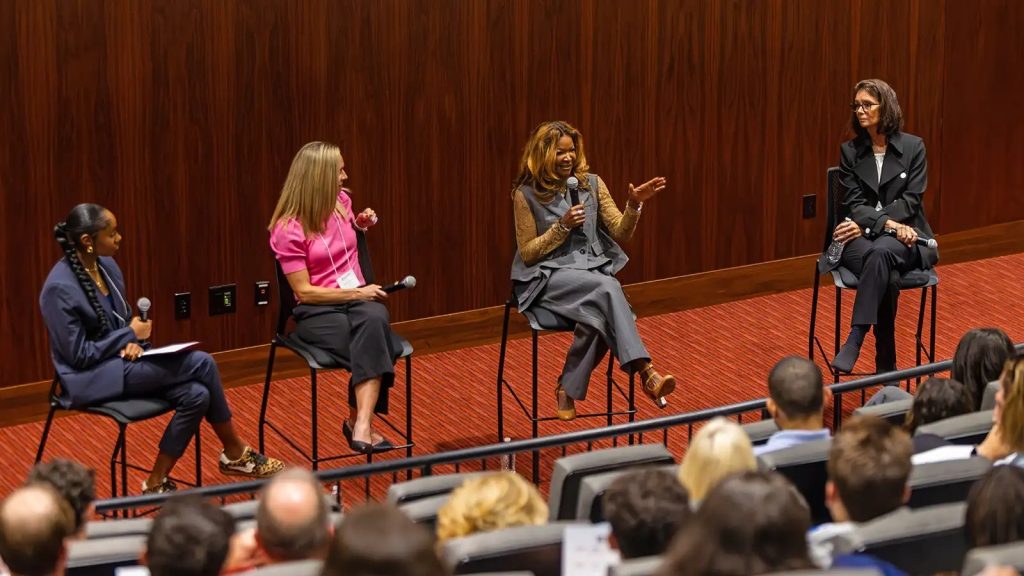
Tamika Tremaglio P’25 (with microphone) speaks to attendees at the 2024 WINS Forum held Nov. 8 in Turner Theatre. Pictured are Chanelle Smith-Walker ’15 (from left), Kyle Lubrano, Tremaglio and Theresa Wenzel. Photo credit: Aidan Blake ’26.
- Samantha Coury ’13 (White female), director of advertising strategy and planning at the PGA TOUR, shared life-earned wisdom through a blend of candor and humor on April 28, 2025.
- Michael Tessler, CEO and Founder of LA-based Multihouse Productions, offered advice and guidance to Elon in LA students, on March 27, on navigating the new creative landscape. He is White and part of the LGBTQ community.
- Dean Baquet (Black male), the Pulitzer Prize-winning journalist and former executive editor of The New York Times, moderated a panel discussion spotlighting the North Carolina journalists who provided essential news coverage during Hurricane Helene and its historic flooding. The panel was organized by the North Carolina News Network and the Open Government Coalition, both part of Elon University, but it was held in North Carolina Central University, in Durham, on January 14. Panelists included journalists Patricia Serrano (Enlace Latino NC, Latinx woman), Julio Tordoya (JMPRO Community Media, Latinx man), Laura Lee (Blue Ridge Public Radio, White woman), Moss Brennan (Watauga Democrat, White man), Jacob Biba (Citizen-Times, White man), and Travis Long (News & Observer, White man).
- Allison Carter ’09 (White female who identifies as LGBTQIA) shared with Elon students her inspiring journey from an uncertain post-graduation start to becoming executive editor of PR Daily. This happened on Nov.14 in the Snow Atrium, in front of dozens of students, after being honored with Elon Comm’s Outstanding Alumna Award.
- María Ramírez Uribe’20 (Latinx female), immigration reporter at PolitiFact, an online fact-checking platform operated by the Poynter Institute for Media Studies, spoke to Elon students on Oct.25 about the importance of deep in topical subjects, translating complex issues into digestible stories, and making sure that facts are, indeed, facts.
Diversity topics in the classroom
Examples of how the school’s faculty included inclusive excellence topics or experiences in the classroom are simply too numerous to be fully captured here. However, we present a list of selected examples at the end of this report, under the section “2024-2025 Inclusive Excellence Faculty Activity Report.” These examples of inclusive excellence-related work include mostly in-classroom contents and activities, but also professional activity, as described by faculty members in their Unit I reports (annual reports). See Appendix 1.
Graduating seniors’ perceptions of their knowledge about inclusive excellence competencies
Every year, the School of Communications conducts a survey with graduating seniors that includes questions about these seniors’ perceptions on their knowledge about competencies related to inclusive excellence. For example, the SoC asks seniors whether their classes included discussions about race & ethnicity, the multicultural history of the communication professions, economic class, gender & sexuality, and diverse political points of view. It also asks seniors if they had class projects in which they interacted with classmates of different races and ethnicities, and whether they feel they gained tools to advocate for people of diverse backgrounds. The results for 2024-2025 are the following, for a sample of 259 seniors. Results are presented in cumulative percentages, first by major and then as a total.
Table 1. Cumulative (in percentages): Diversity Engagement by Major (N = 259)
(Marked in yellow are the cumulative percentages of Agree + Strongly Agree)
Note 1: All the statements in this part of the Seniors Survey started with, “During my time as a student in the School of Communications, in my classes we had discussions about…”
| Question | Answer | CDE | CTA | JOU | MEA | STC | Subtotal |
| Q11_1 (Discussions about race/ethnicity) | Strongly agree | 31.2 | 56.1 | 36.8 | 37 | 48.6 | 45.9 |
| Agree | 59.3 | 84.2 | 68.4 | 88.9 | 83.5 | 79.9 | |
| Slightly agree | 84.3 | 98.2 | 100 | 96.3 | 97.3 | 95.9 | |
| Neither agree nor disagree | 96.8 | 98.2 | 100 | 96.3 | 98.2 | 97.9 | |
| Slightly disagree | 99.9 | 100 | 100 | 100 | 100 | 99.9 | |
| Disagree | 0 | ||||||
| Strongly disagree | 0 | ||||||
| Valid cases | 32 | 57 | 19 | 27 | 109 | 244 |
| Question | Answer | CDE | CTA | JOU | MEA | STC | Subtotal |
| Q11_2 (Discussions about multicultural history of communication professions) | Strongly agree | 25 | 47.4 | 36.8 | 33.3 | 43.1 | 40.2 |
| Agree | 46.9 | 72 | 63.1 | 62.9 | 66 | 64.4 | |
| Slightly agree | 75 | 87.8 | 78.9 | 88.8 | 84.3 | 84.1 | |
| Neither agree nor disagree | 87.5 | 91.3 | 78.9 | 92.5 | 88.9 | 89 | |
| Slightly disagree | 93.7 | 96.6 | 94.7 | 96.2 | 97.2 | 96.4 | |
| Disagree | 99.9 | 100.1 | 100 | 99.9 | 100 | 100.1 | |
| Strongly disagree | 0 | ||||||
| Valid cases | 32 | 57 | 19 | 27 | 109 | 244 |
| Question | Answer | CDE | CTA | JOU | MEA | STC | Subtotal |
| Q11_3 (Discussions about economic class) | Strongly agree | 12.5 | 24.6 | 31.6 | 22.2 | 25.7 | 23.8 |
| Agree | 34.4 | 45.7 | 42.1 | 48.1 | 46.8 | 44.7 | |
| Slightly agree | 68.8 | 70.3 | 68.4 | 77.7 | 79.8 | 75 | |
| Neither agree nor disagree | 78.2 | 82.6 | 68.4 | 85.1 | 84.4 | 82 | |
| Slightly disagree | 78.2 | 87.9 | 84.2 | 92.5 | 95.4 | 90.2 | |
| Disagree | 93.8 | 96.7 | 100 | 99.9 | 99.1 | 98 | |
| Strongly disagree | 100 | 100.2 | 100 | 99.9 | 100 | 100 | |
| Valid cases | 32 | 57 | 19 | 27 | 109 | 244 |
| Question | Answer | CDE | CTA | JOU | MEA | STC | Subtotal |
| Q11_4 (Discussions about gender and sexuality) | Strongly agree | 18.8 | 50.9 | 36.8 | 14.8 | 33.9 | 34 |
| Agree | 43.8 | 70.2 | 42.1 | 48.1 | 61.4 | 58.2 | |
| Slightly agree | 81.3 | 89.5 | 68.4 | 88.8 | 82.5 | 83.6 | |
| Neither agree nor disagree | 87.5 | 93 | 84.2 | 92.5 | 91.7 | 91 | |
| Slightly disagree | 93.7 | 100 | 100 | 96.2 | 98.1 | 98 | |
| Disagree | 96.8 | 100 | 100 | 99.9 | 99.9 | 99.6 | |
| Strongly disagree | 99.9 | 100 | 100 | 99.9 | 99.9 | 100 | |
| Valid cases | 32 | 57 | 19 | 27 | 109 | 244 |
| Question | Answer | CDE | CTA | JOU | MEA | STC | Subtotal |
| Q11_5 (Discussions about diverse political points of view) | Strongly agree | 31.2 | 22.8 | 42.1 | 22.2 | 36.1 | 31.3 |
| Agree | 53.1 | 40.3 | 57.9 | 55.5 | 66.7 | 56.8 | |
| Slightly agree | 75 | 66.6 | 79 | 77.7 | 87.1 | 79 | |
| Neither agree nor disagree | 81.2 | 75.4 | 89.5 | 81.4 | 89.9 | 84.3 | |
| Slightly disagree | 90.6 | 85.9 | 94.8 | 92.5 | 95.5 | 92.1 | |
| Disagree | 100 | 96.4 | 100.1 | 92.5 | 97.4 | 97 | |
| Strongly disagree | 100 | 99.9 | 100.1 | 99.9 | 100.2 | 99.9 | |
| Valid cases | 32 | 57 | 19 | 27 | 108 | 243 |
| Question | Answer | CDE | CTA | JOU | MEA | STC | Subtotal |
| Q11_6 (Class projects with people of different races or ethnicities) | Strongly agree | 28.1 | 33.3 | 42.1 | 25.9 | 31.2 | 31.6 |
| Agree | 59.3 | 59.6 | 68.4 | 51.8 | 52.3 | 56.2 | |
| Slightly agree | 78.1 | 85.9 | 73.7 | 77.7 | 81.7 | 81.2 | |
| Neither agree nor disagree | 84.3 | 89.4 | 84.2 | 96.2 | 90 | 89.4 | |
| Slightly disagree | 93.7 | 92.9 | 84.2 | 96.2 | 96.4 | 94.3 | |
| Disagree | 99.9 | 99.9 | 100 | 96.2 | 99.2 | 99.2 | |
| Strongly disagree | 99.9 | 99.9 | 100 | 99.9 | 100.1 | 100 | |
| Valid cases | 32 | 57 | 19 | 27 | 109 | 244 |
| Question | Answer | CDE | CTA | JOU | MEA | STC | Subtotal |
| Q11_7 (Media activities with people of different races/ethnicities) | Strongly agree | 28.6 | 46.3 | 41.2 | 22.2 | 31 | 34.1 |
| Agree | 53.6 | 75.9 | 70.6 | 59.2 | 54 | 61.1 | |
| Slightly agree | 71.5 | 88.9 | 76.5 | 77.7 | 81 | 81 | |
| Neither agree nor disagree | 85.8 | 96.3 | 94.1 | 88.8 | 87 | 89.8 | |
| Slightly disagree | 92.9 | 100 | 100 | 88.8 | 94 | 95.1 | |
| Disagree | 100 | 100 | 100 | 96.2 | 99 | 99.1 | |
| Strongly disagree | 100 | 100 | 100 | 99.9 | 100 | 100 | |
| Valid cases | 28 | 54 | 17 | 27 | 100 | 226 |
| Question | Answer | CDE | CTA | JOU | MEA | STC | Subtotal |
| Q11_8 (Gain tools to advocate different background) | Strongly agree | 43.8 | 59.6 | 52.6 | 33.3 | 51.4 | 50.4 |
| Agree | 65.7 | 84.2 | 84.2 | 74 | 82.6 | 79.9 | |
| Slightly agree | 81.3 | 96.5 | 94.7 | 96.2 | 94.5 | 93.4 | |
| Neither agree nor disagree | 96.9 | 100 | 100 | 99.9 | 98.2 | 98.7 | |
| Slightly disagree | 100 | 100 | 100 | 99.9 | 100 | 99.9 | |
| Disagree | 0 | ||||||
| Strongly disagree | 0 | ||||||
| Valid cases | 32 | 57 | 19 | 27 | 109 | 244 |
Note 2: Totals may not always equal exactly 100% due to rounding to one decimal place.
These results for the 2024-2025 survey are similar to or slightly better than those for the 2023-2024 survey. The item that remains below 50% is the one on discussions about economic class (44.7%). However, in all the categories, if the “slightly agree” value is added, then the results range between 69% and 93%.
Alumni perceptions of their knowledge about competencies related to inclusive excellence
Every three years, the School of Communications conducts a survey with SoC alumni about different areas, including what they learned about inclusive excellence while they were students in the school. The most recent results, from the Alumni Survey conducted in 2022, are included in the SoC Report for 2023-2024, which can be found in the SoC’s Inclusive Excellence website. The next set of results will be available for the 2026-2027 report.
EPortfolios Assessment
The results for the evaluation of senior exit portfolios conducted in the spring of 2024, which included a reflection on whether students learned about inclusive excellence while at Elon and feel prepared to work with and advocate for diverse teams, were included in the SoC Inclusive Excellence Report for 2023-2024, which can be found in the SoC’s Inclusive Excellence website. This assessment was not conducted in the spring of 2025.
Student Recruitment and Retention
The School of Communications’ dean and associate dean, as well as different faculty members collaborate with Elon’s Admissions Office to support their events. As such, we serve as panelists for Admissions gatherings with prospective students and their parents, and school faculty teach mock classes during Phoenix Fusion Weekend, where underrepresented students are invited to spend the weekend on campus. The dean and associate dean meet monthly with the Admissions Dean and other senior staff members. The School of Communications Fellows Program Director also meets with Admissions staff regularly.
Several professors from the school participate in Zoom informational Admissions events at Elon such as Viva Elon!, Black Advance, API Achieve and PRIDE Raise, and in in-person Admissions events such as Phoenix Fusion (where accepted students from underrepresented backgrounds spend a weekend on-campus and attend mock classes).
Additionally, the school has a summer Emerging Journalists Program (EJP) for high-school students. Funded by the Scripps Howard Foundation between 2021 and 2024, it is supported now by the university. High school students from around the country apply and are selected to immerse themselves in journalism, either online (through four interactive learning sessions) or in person, for two weeks, in a journalism bootcamp. The online version was attended by 170 students in summer of 2025. For the more selective on-campus immersive version, the about 20 chosen students come from underrepresented groups (race, ethnicity or socioeconomic status). Many leave so impressed with the experience that they decide to major in journalism. The program has unintendedly also become an admissions tool. The yield for these students is higher than that for the Communications Fellows program, which is above 60%. In its fifth year (summer of 2025), the on-campus immersion program accepted 18 students.
Furthermore, the school’s director of student engagement and special projects, Colin Donohue, provides the Admissions Office with names of prospective students who have visited the school through personalized tours or interacted with school faculty to identify particularly promising students and ask Admissions to monitor them. And during Fellows/Scholarships Weekend, school faculty conduct Saturday interviews with prospective students but also interact with them on a social that is held on a Friday night. At those moments, faculty try to make sure all students —including underrepresented ones— feel seen and welcomed at Elon.
Regarding scholarship funds, beyond all the scholarships offered at the university level, the Dean’s Office maintains some financial support for students who need additional funding to complete internships and research/creative projects. These funds are not for new students, but they help with the retention of some underrepresented students.
The following are the School of Communications student retention and graduation rates, compared to Elon University as a whole.
Table 2. School of Communications Retention Rates — Class of 2024 (student cohort that started at Elon University in fall 2020).
Retention:
| Class of 2024 | Cohort | Soph Yr | Junior Yr | Senior Yr |
| COM Students Total | 307 | 281 (91.5%) | 279 (90.9%) | 274 (89.3%) |
| COM Minority Students | 41 | 36 (87.8%) | 35 (85.4%) | 33 (80.5%) |
| All Elon Students | 1,586 | 1,392 (87.8%) | 1,314 (82.8%) | 1,273 (80.3%) |
| All Minority students | 283 | 244 (86.2%) | 220 (77.7%) | 211 (74.6%) |
Graduation:
The students with any COM major as last-declared major for the Class of 2024 were 307. Of those, 268 (87.3%) graduated in four years. The minority students with any COM major as last-declared major for the Class of 2024 were 41. Of those, 31 (75.6%) graduated in four years.
The entire Elon University entering-cohort in fall 2020 was 1,586 students. Of those, 1,225 (77.2%) graduated in four years. The minority students in the entire university entering-cohort for 2020 were 283. Of those, 200 (70.7%) graduated in four years.
Student Demographics
In terms of student body composition, students in the School of Communications have the following demographics (in comparison with the student body at Elon University):
Table 3. School of Communications’ Student Demographics
Academic year: 2024 – 2025
Total number of Elon University students: 6561.
Total number of COM majors: 937. Male: 240 (26%). Female: 697 (74%). These numbers do not include Sport Management (SPT) majors. Table 4 (below) presents SPT student demographics.
| Group | Male | Female | % of total in unit | % of total in institution |
| Black/African-American | 12 | 31 | 4.59 | 5.24 |
| White | 190 | 560 | 80.04 | 74.86 |
| American Indian/Alaskan native | 0 | 0 | 0 | 0.15 |
| Asian | 4 | 12 | 1.71 | 2.20 |
| Hispanic/Latino (any race) | 13 | 51 | 6.83 | 7.22 |
| Native Hawaiian/other Pacific Islander | 0 | 0 | 0 | 0.03 |
| Two or more races | 10 | 15 | 2.67 | 3.23 |
| Other race | 9 | 22 | 3.30 | 5.21 |
| International students (any race) | 2 | 6 | 0.85 | 2.02 |
For the Sport Management Department, the student demographics breakdown was the following for 2024-2025. This information is presented separate from Table 7 because this department is accredited through COSMA, a different accrediting body than ACEJMC, which accredits the other majors in the SoC (Strategic Communications, Cinema & Television Arts, Journalism, Communication Design and Media Analytics).
Table 4: SPT Majors Based on Race/Ethnicity
| Academic Year | American Indian | Asian | Black/African American | Hispanic/Latino | Two or more races | Unknown | White | Total |
| AY2020-21 | 12 | 4 | 9 | 1 | 157 | 183 | ||
| AY2021-22 | 14 | 8 | 6 | 1 | 166 | 195 | ||
| AY2022-23 | 1 | 16 | 8 | 8 | 3 | 160 | 196 | |
| AY2023-24 | 1 | 3 | 13 | 9 | 9 | 4 | 191 | 232 |
| AY2024-25 | 1 | 4 | 13 | 13 | 11 | 14 | 213 | 269 |
Diverse & Culturally Proficient Faculty
As of the end of spring 2025, 33 percent of the full-time faculty in the School of Communications were from minority communities and 40 percent were female. Seven of the nine faculty members hired into full-time positions during the past five years have been women (78 percent), and four (44 percent) have added to the faculty’s racial, ethnic and international diversity. Table 5 and Table 6, respectively, present the demographics of full-time faculty and part-time faculty as of the spring of 2025.
Table 5. Full-time Faculty, Spring 2025
Total: 58 (100%). Gender: Male = 32 (55%); Female = 23 (40%); Non-Binary = 3 (5%)
White: 72.5%
Non-White: 27.5%
| Group | Female | Percentage of total faculty | Male | Percentage of total faculty | Non-binary | Percentage of total faculty |
| Black/African American | 3 | 5.2% | 3 | 5.2% | ||
| Native American | 1 | 1.7% | ||||
| Hispanic/Latino (any race) | 1 | 1.7% | 1 | 1.7% | ||
| Asian | 3 | 5.2% | 2 | 3.4% | ||
| International faculty (any race) | 2 | 3.4% | ||||
| White | 15 | 25.9% | 24 | 41.4% | 3 | 5.2% |
Table 6. Part-time/adjunct faculty, Spring 2025
Total: 11. Male: 7; Female: 4.
| Group | Female | Percentage of faculty | Male | Percentage of faculty |
| Black/African American | 1 | 9% | ||
| Native American | ||||
| Asian | ||||
| White | 4 | 36% | 6 | 55% |
The School of Communications strives to recruit and support diverse faculty and staff. Faculty search committees are joined by the school’s dean and/or an Elon HR representative to discuss and emphasize the importance of attracting candidates with diverse backgrounds.
Faculty search committees include a diverse combination of members in gender, race, ethnicity and seniority level at Elon. Intentional measures are taken so the recruiting process is equitable for all candidates (regarding activities during on-campus visits, questions asked during remote and on-campus interviews, etc.). The hiring process also accommodates the particular needs of candidates with disabilities, various religious traditions, specific meal requirements and lactation-space needs, among others. The school conducted one faculty search in 2024-2025 for its Sport Management department. Among all the applicants, the two finalists were from underrepresented groups (a woman and a non-binary applicant). Associate professor Lindsay Pieper was hired for the job, and she will start at Elon in fall 2025.
Retention is also an important part of having diverse faculty and staff. At the university level, all new-faculty members across the university form a cohort through a one-year orientation process offered by Elon’s CATL (Center for the Advancement of Teaching and Learning). This orientation encompasses monthly sessions centered on engaged pedagogies and techniques, how to navigate a new institution of higher education, and how to write effective annual reports (Unit Is), among other topics. In some of these sessions there are also invited guests from across campus, such as from Human Resources and Elon’s FR&D (Faculty Research & Development) committee. These monthly sessions are formative and allow new faculty members to network.
At the School of Communications level, each new faculty member is assigned a senior faculty mentor within the school. These mentors guide new faculty in their transition to the life of the university and through the culture and nuances of the School of Communications. The mentorship happens formally for one year, but in practice, mentoring relationships continue informally for the long-term. Mentor-mentee pairs are encouraged to meet regularly over coffee or lunch, and the school covers all costs.
One measure of success related to these support systems is the fact that the school’s faculty members have been highly successful in attaining tenure and promotion to Associate Professor, promotion to Full Professor, or continuance (in continuing track appointment). For instance, in 2025, the following colleagues received promotion and/or tenure:
- Jenny Jiang (tenure and promotion to associate professor),
- Cara Lucia (promotion to full professor)
- Nichole Triche (promotion to full professor)
- Brandon Booker (promotion to senior lecturer)
Faculty Inclusive Excellence
In this 2024-2025 academic year, School of Communications faculty members demonstrated inclusive excellence in numerous ways. For example, several are engaged in efforts at the university level, by serving in roles such as co-Chair of the Hispanic/Latinx Advisory Council, co-Coordinator of the Latinx Employee Resource Group, member of PACIE (Elon’s Presidential Advisory Council for Inclusive Excellence), member of the Asian and Pacific Islander & Middle East and North Africa (API & MENA) Implementation Team, member of the Advancing Equity Requirement (AER) Committee, and member of the group Elon Partners & Allies. The School of Communications also has an Inclusive Excellence Committee that advises the dean’s office and, among other activities, organizes the annual Spotlight on Inclusive Excellence event.
Other important contributions by SoC faculty that are connected to inclusive excellence work at Elon and in our professional fields are the following:
- Lee Bush, professor of strategic communications, and Karen Lindsey, assistant professor of strategic communications, published a textbook titled “Diversity, Equity, and Inclusion in Strategic Communications: Becoming Culturally Proficient Communicators.” The book was released by Routledge Taylor & Francis on August 15, 2024, and it features chapters from school faculty members Vanessa Bravo, Qian Xu and Michele Lashley, as well as chapters from both Bush and Lindsey. Bush and Lindsey teach most sections of the newly required course COM 2000 Inclusive Communications.
- Associate Professor of Sport Management Cara Lucia published a special issue of the Recreational Sports Journal, dedicated to exploring justice, diversity, equity and inclusion (JDEI) in recreational sports and higher education. Released on Oct. 18, the edition offers a thought-provoking collection of research and perspectives designed to drive inclusivity and create more welcoming environments in collegiate recreation and beyond.
- Lecturer Staci Saltz moderated “Navigating the Challenges: Effective Strategies for Teaching DEI Amidst Pushback,” a panel at BEA’s (Broadcast Education Association) annual conference that examined strategies for maintaining and promoting diversity, equity, and inclusion in the curricula. Panelists included Elon strategic communications professors Karen Lindsey and Jessalynn Strauss.
- Assistant Professor Karen Lindsey was a guest speaker for inclusive excellence-related sessions organized by the American Psychological Association and Tulane University Public Relations Student Society of America (PRSSA).
- Other examples of how SoC faculty connect their teaching, conducted professional activity or developed scholarship related to inclusive excellence can be found in the Appendix 1 section, at the end of this report.
SoC faculty are engaged in the professional and local community, including serving on boards of organizations such as the Women’s Resource Center in Alamance County, the Alamance County YMCA, the Harwood Institute/Alamance Impact initiative in Alamance County, and the Diversity Action Alliance. One faculty member also served as past-Chair of the International Communication section of ISA (International Studies Association) and as Vice-Chair of the Minorities and Communication (MAC) Division at AEJMC, and another serves in the NCAA (National Collegiate Athletic Association) Diversity, Equity, and Inclusion Committee. Journalism and strategic communications faculty members are part of the National Association of Black Journalists (NABJ) and the National Association of Hispanic Journalists (NAHJ).
SoC’s faculty also participated in multiple training sessions and webinars centered on inclusive excellence through Elon’s Advancing Equity Summer Institute, Elon’s Inclusive Teaching Certificate program (offered by the Center for the Advancement of Teaching and Learning and the Office of Inclusive Excellence Education and Development), the Leading with Equity Lunch “Addressing privilege, power and difference,” the “Addressing Implicit Bias” workshop of Elon’s Center for Design Thinking, the “Building on and communicating your commitment” session of Elon’s Division of Inclusive Excellence, and more. See Appendix 1, at the end of this document, for the full list.
School faculty attended external inclusive excellence trainings, including a 6-day Racial Equity Faculty Recruitment Workshop offered by Penn State University; the Latine Education Summit in Winston Salem, hosted by the NGO LatinxEd; the session Intersectionality of Design and Accessibility at AIGA’s national conference; and more. See Appendix 1, at the end of this document, for the full list.
Of note, this AY2024-2025 the SoC Faculty Excellence in Inclusive Excellence Award went to Dr. Cara Lucia, chair of the Department of Sport Management. Her work centers on diversity, equity, inclusion and social justice in her teaching, her research, and her service, as chair of the Department of Sport Management and president of NIRSA, the National Intramural and Recreational Sports Association.
Inclusive Climate
Elon University periodically participates in externally conducted campus climate surveys for faculty and staff, as well as for students. The most recent surveys were HEDS (Higher Education Data Sharing Consortium, for faculty) in 2023 and the MSL Survey (Multi-Institutional Study of Leadership, for students) in 2021. These surveys have different cycles, so the SoC will have updated results after academic year 2026-2027. The aforementioned surveys’ results were included in the school’s Inclusive Excellence Report for 2023-2024, which can be found here. Both sets of results reflect that the faculty and the students in the School of Communications have a positive outlook about the inclusive climate in the school, with averages above the university level.
Following are some ways in which the School of Communications aims to create and maintain a supportive environment for students, faculty and staff:
- As part of valuing the contributions of all forms of diversity, school faculty seek to recruit underrepresented students during the Communications Fellows/Scholarship Weekend and identify work by underrepresented students to include it in their nominations for the school’s annual Student Awards.
- The school supports all its students, whenever possible, to be recognized for their academic or leadership work, at Elon and beyond, and this effort includes promoting underrepresented students’ work to achieve recognition beyond Elon University. For example, in 2024-2025:
- Cristy Mariné ’25, a double major in cinema & television arts (BFA) and strategic communications, was selected in spring 2025 for a Fulbright grant to pursue a master’s degree in creative industries at the University of Exeter in the United Kingdom. Mariné was also selected to participate in a 2-day IRTS Foundation Multicultural Career Workshop, in New York.
- Sabrina Mannnes Diaz de Cerio ’25, a strategic communications major, earned a spot in the American Advertising Federation’s Most Promising Multicultural Students Program. She participated in March in a 4-day immersion program in New York.
- Evelyn Ealey’26, strategic communications and dance performance & choreography double major, was recognized in October with the Just Drive Media Communications Fellowship, receiving a $5,000 scholarship and a paid internship with the communications agency Just Drive Media. She also attended PRSSA’s national conference in Anaheim, Calif., supported by the School of Communications.
- Taylor Duque ’27, a Communications Fellow and a scholar in the Odyssey Program, was awarded a fellowship from LatinxEd, an educational initiative that supports Latinx students and immigrant families in North Carolina aspiring to excel in higher education. As part of it, she participated in the annual conference LatinxEd Summit, in Winston-Salem.
- Lilly Molina ’27, Odyssey Scholar and Communications Fellow, was selected for a 2025 Pulitzer Center Reporting Fellowship. A student media leader at Elon News Network and a recent contributor to La Noticia, Molina will use the fellowship to investigate illegal hammerhead shark fishing off the coasts of Costa Rica.
- The SoC created the Unity in Communications program in the fall of 2021 to connect students interested in “enhancing diversity and inclusion in the communications and sport management industries.” With support from the dean’s office, this student-run program organizes lectures, discussions, and other special activities. In AY2024-2025, the group started having a new staff advisor, Karla Estrada Pérez, supported by Assistant Dean Vanessa Bravo, to reinvigorate the group and its activities. For example, there were three program meetings in the fall semester, including a Meet and Greet with Faculty and Professors in November. In the spring semester, Unity in Communications had a general meeting in March (with information, a bingo game and empanadas) and a Student Professional Development Center (SPDC) workshop in April. The group also elected its new leadership team: Lauren McOhen (President) and Lydia Briones (Social Media Manager). The position of Secretary & Outreach Coordinator has yet to be filled.
Special Programming
This academic year, the School of Communications hosted events such as the following:
- Organized by the school’s Inclusive Excellence Committee, the Spotlight on Inclusive Excellence event, held on Feb. 25 in Snow Family Grand Atrium included a 75-minute program that featured a dynamic speed-rotation format, allowing the nearly 100 students, faculty, staff and alumni in attendance to engage in meaningful discussions at various table topics every 15 minutes. The roundtable conversations covered a broad range of issues related to inclusivity in communications, journalism, and the media. Subjects included the role of student media in promoting campus diversity, investigative journalism as a tool for equity, and the importance of understanding cultural narratives beyond surface-level storytelling. Other topics explored strategic communications for inclusive excellence initiatives, community organizing for change, and the unique experiences of international students navigating cultural differences. Additionally, the students and faculty discussed the underrepresentation of women in sports and influencer marketing, newsroom challenges faced by neurodiverse journalists, and the power of film in broadening cultural perspectives.Together, topics for this event fulfill several objectives of the school’s DEI plan, including:
- Create programming where students from all majors and identities can come together, get to know each other, and share student experiences.
- Infuse and promote DEI as part of engaged/experiential learning.
- Create opportunities for students of diverse backgrounds to be recognized and talk about their cultures.
- The School of Communications hosted its fourth Scripps Howard Emerging Journalists Program (EJP) online and on campus, supporting journalism in diverse and underserved communities and educating high school students who are interested in pursuing careers in journalism. Senior Lecturer Kelly Furnas and Colin Donohue, director of Student Engagement and Special Projects and instructor in Journalism, coordinated the program. This academic year, the school provided 4 virtual sessions and hosted on campus, in the summer of 2024, 18 students from underrepresented socioeconomic, racial and ethnic groups from around the country, to teach them the fundamentals of journalistic research, interviewing, writing, photography, design, videography, editing, and producing, during a 12-day residential immersion program. Students produced a newspaper, aired a broadcast and launched a website during the program. Since 2021, about 60% of the participants of EJP enroll at Elon. In the summer of 2025, the SoC accepted a cohort of 18 participants in its immersive, on-campus bootcamp.
Student Organizations
Live Oak Communications has had a DEI Plan in place since 2023. The student-run agency also abides by the Diversity Action Alliance pledge, and it works with local and national clients, including through a partnership with the Alamance County Chamber of Commerce, whereby Live Oak students will work with at least one client per year that is minority or BIPOC-owned, or whose business directly works toward DEI and community engagement.
Communications
The School of Communications at Elon has, in its website, an Inclusive Excellence section where it provides yearly Inclusive Excellence reports. This webpage also features the school’s current DEI Plan (approved in 2023 for 2023-2028) and the previous one. A list of news stories that showcase some inclusive excellence-focused events and accomplishments is also updated periodically and organized by year.
Appendix 1
2024-2025 Inclusive Excellence Faculty Activity Report
The following are 20 selected examples of how faculty in the School of Communications connect their teaching and professional activity to inclusive excellence. This list is not exhaustive, but it provides an overview. It is followed by a selected list of trainings that faculty in the School of Communications took this academic year to enhance their knowledge on inclusive excellence-related topics. The following abbreviations are used in this list: CDE (Communication Design), CTA (Cinema & Television Arts), JOU (Journalism), MEA (Media Analytics), SPT (Sport Management), and STC (Strategic Communications).
Teaching and Mentoring
- This year, Strategic Campaigns students developed work for clients of a diverse range. Among others, those clients included the Salvation Army Boys and Girls Club of Alamance County, Sustainable Alamance (a local program devoted to helping formerly incarcerated individuals locate resources for employment and living), Benevolence Farm (which works with women who were formerly incarcerated in Alamance County), and the Family Justice Center of Alamance County (which provides support to victims of family violence and elder abuse).
Other selected examples, culled from individual faculty members in their Unit Is (annual reports), are (quoted from their reports):
- Sowjanya Kudva (CTA): They mentored many students in meaningful ways. For example, Sowj mentored a student who shared, on the first day of class, that she felt that students of color were pushed to the margins and rarely offered crew positions by fellow students in student-run production environments. Assistant professor Kudva, who mentored the student and helped her create the group Film in Color, wrote, in their Unit I, “She understood that she and other students of color could not learn and grow without on-set experiences in major crew roles: directing, producing, shooting, editing, etc. In putting together a club called Film in Color, she provided a space for students of color to lead productions. She was not an overbearing leader. She created the architecture within which students could explore, and she stepped back, listened, and operated solely to support younger students in the peer-mentorship she had craved for herself. Though she was graduating early, she managed to conduct weekly meetings, offer workshops, and complete a short film production crewed entirely by students of color.” This student is now pursuing a master’s degree at Northwestern University. Sowj also moderated a roundtable at the GLC Annual LGBTQIA+ New Student Welcome the first week of class. They joined several other LGBTQIA+ faculty to have 40-minute conversations with new LGBTQIA+students at Elon. Additionally, they presented to students during the GLC’s Transgender Day of Visibility.
- Sydney Nicolla (STC): She introduces students to standpoint theory in her Strategic Writing classes. Standpoint theory allows people to understand how they come to have their worldview, and how important it is to keep in mind the experiences that formed somebody’s perspectives. She wrote, in her Unit I, “I asked students to reflect on their own standpoint and pieces of their identity that shaped it. We considered how these might influence our tendencies in thought, action and writing. This fall, I added a new exercise by asking students to complete an implicit bias test. Though we discussed the inherent limitations of implicit bias tests, students found it to be a thought-provoking experience (even when they disagreed with or distrusted their results). I believe that this exercise helped them to better grasp the concept of implicit bias.”
- Shaina Dabbs (SPT): In her sport management SPT 4970 course, students completed a module titled “Sexual Harassment Dilemma.” Students were presented with a realistic case involving sexual harassment on a college campus. In her Unit I, Dabbs, wrote, “Acting as athletic administrators, students developed evidence-based solutions and engaged in a discussion about their strategies, the case, and the importance of fostering a safe environment for everyone. Students also completed a Q&A assignment reflecting on fairness, equality, and ethics inspired by the module.”
- Rebecca Bagley (CDE): For every project critique, she uses a set list of questions with students to guide classroom and peer feedback. These include specific questions about diversity, equity and inclusion, such as whether a design unintentionally excludes certain groups or supports unconscious bias. This process has been highly educational, uncovering issues that might otherwise go unnoticed when viewed through an inclusive excellence lens. Also, across all design courses, she dedicates time to teaching students how to design for disabilities and visual impairments. For example, her classes examine how poor color contrast can affect readability for people with visual challenges.
- Kai Swanson (CTA): Since 2024, Swanson’s approach to teaching about diversity, equity and inclusion in film and media courses became “more data-driven, industry-focused, and student-engaged.” They wrote in their Unit I, “Rather than presenting diversity as an abstract ideal, I positioned it as a critical industry issue tied to hiring, funding, and audience trends. Students responded positively to this approach, engaging in meaningful discussions backed by data and case studies rather than personal anecdotes.” Swanson is also a member of the university Advancing Equity Requirement (AER) Committee.
- Israel Balderas (JOU): He connected his Media Law and Ethics class with Assistant Professor Matthew Young’s Polarization & Civil Discourse class during Winter Term 2025 to engage in a discussion on book bans and their implications for intellectual freedom, equality and First Amendment protections.
- Nicole Triche (CTA) and Sydney Nicolla (STC): These two professors worked together with their respective groups (Triche’s elondocs students served as producers and Nicolla’s Strategic Campaigns students collected information) to produce short videos for the local non-profit Benevolence Farm (including shooting B-roll and recording interviews with 7 residents/members of this organization). The deliveries were a communications campaign proposal and seven short videos that can be used for promotion and fundraising purposes. Benevolence Farm’s flagship program offers transitional housing and employment to “provide a space for women and gender expansive people returning home from prison and jail to process, heal, and prepare for what’s next.” Triche wrote, in her Unit I (annual evaluation report), about this experience, “We invited the participants to a premiere screening of the videos in McEwen 013 followed by ice cream. Our students spend four years in Alamance County, but many do not interact with the community beyond Elon. It has been so fulfilling to see the students use their talents to give back to Alamance County.”
- Ahmeed Fadaam (CDE): In his Unit I, about his approach to teaching, assistant professor Fadaam wrote, “As someone who identifies with a minority group, I emphasize that DEI is a global issue, not just an American one. By broadening the scope of our discussions, I help students develop cultural awareness and empathy, encouraging them to understand that DEI challenges are not limited to the U.S. In my global studies courses, we explore topics like stereotyping, racism, marginalization, discrimination, and the effects of socio-economic and cultural differences. In my lab classes, while DEI discussions are more limited due to the technical nature of the courses, I make an effort to highlight the accomplishments of minority professionals in the field.”
- Ray Johnson (CTA): In his CTA 3060 (Development of the Cinema) course, he significantly revised the syllabus this year to include more diversity, dedicating the second half of the course to women filmmakers and filmmakers of color. In his Unit I, he wrote, “We studied pioneers like Alice Guy-Blaché and contemporary directors like Greta Gerwig and Jane Campion. The class studied the controversy surrounding the concept of the “female gaze” in cinema. Personal experiences with Spike Lee and discussions on filmmakers of color further enriched the course. We also considered early filmmakers of color like Oscar Micheaux, Noble Johnson, and Spencer Williams, who created independent films for black audiences in the 1910s and 1920s, known as race films. The revised syllabus included a focus on the contributions of LGBTQ+ filmmakers and the representation of LGBTQ+ characters in cinema. I shared with students the work of two Elon graduates, Martin Ritt and Kenneth Utt, who worked on several films of social consciousness, including the first major film with all gay characters, Boys in the Band (1970), produced by Kenneth Utt. He also produced the first major film about the AIDS crisis, Philadelphia, in 1993. This comprehensive approach to diversity has been appreciated by students, who have expressed a greater awareness and understanding of the contributions of marginalized groups to the film industry.”
- Randy Piland (CDE): For the fifth year, he included an exercise in his Multimedia Journalism class called “Let’s Educate Each Other,” where students selected and presented topics in recent articles published in the 2021 Neiman Report “Racial Reckoning.” The class was split into six groups, each reporting on an issue. The topics were the following: Getting Race Right; Tension is High, Trust is Low; Recognition and Reckoning; You Want to Do Better Reporting? Hire People from the People You Are Reporting On; Visual Journalism in a Surveilled Society; and Reporting and Resilience.
- Kelly Furnas (JOU): He uses the Maynard Institute’s “Fault Lines” exercise in JOU 1100 News Writing and Reporting to have students evaluate the inclusion (or exclusion) of demographics in a medium; he uses a semester’s worth of Elon’s student-run newspaper The Pendulum for the exercise. He said that it is “a helpful activity that helps contextualize the importance of diversity in sourcing while also acknowledging the potential pitfalls of quotas or tokenism. In addition, I dedicated a class lecture to a diversity styleguide, walking students through the care that must be taken with word choice in regard to writing about identities and marginalized communities.”
Professional Activity and Service
When reading each faculty member´s Unit I (annual) report, it becomes clear that there is a sustained, intentional and scaffolded process where faculty members are trying to learn, more and more, about diversity, equity, inclusion to apply this knowledge to their courses and outside of the classroom. School of Communications faculty are reading books and articles, attending training sessions on campus and beyond, and following processes of self-reflection. These are some examples of what they did this year:
- Shanetta Pendleton (STC): Published the peer-reviewed journal article “Friend or Faux: Testing the Perceived Authenticity of Corporate Socio-Political Activism Messages on Instagram Through the Lens of Black Lives Matter” in Public Relations Review, one of the top journals in public relations/strategic communications. She presented on this topic, as well, at the Public Relations Division of NCA (National Communication Association)’s conference, in New Orleans. Additionally, she served as an invited panelist at the session Bridging the Divide: Strategies for Teaching Contentious and Polarizing Topics in the Classroom,” organized online by AEJMC’s Commission on the Status of Graduate Education.
- Meg Daniels (CTA): Presented her new film, “I’m Still Here, Love,” both in California (in February) and to the Elon community (in April). It explores the human cost of COVID-19 vaccine mis- and disinformation, including along the lines of race and ethnicity.
- Chris (Cheng) Chen (CDE): Examined in a journal article how serious games – video games designed for purposes beyond entertainment – can tackle important social issues like school bullying. She also published an article examining how racial diversity cues and user feedback shape trust and fairness perceptions in AI systems. The study, titled “Communicating and combating algorithmic bias: effects of data diversity, labeler diversity, performance bias, and user feedback on AI trust,” was published in Human-Computer Interaction, one of the leading research journals in the field.
- Lorraine Ahearn (JOU): Presented the paper “Fake Indians”: Resisting Delegitimization in the Contested Space of Historical Journalism, at AEJMC’s Southeast Colloquium in UNC Chapel Hill.
- Vanessa Bravo (STC): Presented her research on immigrants, diaspora communities and public diplomacy at Universidad Autónoma Metropolitana and Universidad Iberoamericana, both in Mexico City, in November of 2024, where she interacted with undergraduate students, graduate students and faculty members at those institutions. At Elon, she co-advises Unity in Communications, a student organization open to all students that centers on issues of diversity, equity and inclusion in the fields of communication. Besides coordinating this group’s meetings, she organized a Meet and Greet with school’s faculty where students could interact and network with faculty from underrepresented backgrounds.
- Qian Xu (STC and MEA): Wrote the chapter “Inclusive Digital and Social Media Strategies” for Bush and Lindsey’s (2024) book, “Diversity, equity, and inclusion in strategic communications: Becoming culturally proficient communicators.” It emphasizes that DEI principles should and can be applied in every stage of digital communication—from strategy development and execution to evaluation and refinement. By prioritizing social listening, inclusive design, diverse representation, and effectiveness evaluation, organizations can create a more equitable, accessible, and inclusive digital experience.
- Jenny Jiang (CDE and MEA): Joined the URPAC (Undergraduate Research Program Advisory Committee)’s DEI Subcommittee, where she contributed to identify best practices for inclusive mentorship and strategies to support underrepresented student researchers. She also published the co-authored article “Women’s Engagement in Political Discussions on Social Media” in the journal Sex Roles. The study demonstrates how social media enables women to engage in political discourse on par with men, bridging the gender gap regardless of resource levels or gender salience in politics.
- Vic Costello (Cinema & Television Arts): Presented five times in the 11th annual Vision Africa Media Institute in Umuahia, Nigeria, to educate about 400 future media practitioners on how to navigate modern media landscapes. He also conducted in-house training for Vision Africa Radio’s multimedia content producers.
Inclusive Excellence-Related Trainings:
School of Communications faculty participated in inclusive excellence-related trainings at multiple sessions during the year. The following is a selected list of events/organizations that our faculty attended to continue their process of learning about inclusive excellence:
At Elon:
- Global Education Center’s session Managing Bias on Short-Term Study Away Programs
- Winter Term Study Abroad Title IX Training
- CREDE’s Big 8 Workshop
- Advancing Equity Summer Institute (3 full days)
- Inclusive Teaching Certificate (MOOC course offered by the Center for the Advancement of Teaching and Learning -CATL- and the Office of Inclusive Excellence Education and Development)
- BE Aware, BE Accountable, BE Advocates Bias Education Workshops by the Division of Inclusive Excellence
- Summer 2024 “Nice Racism” Book Discussion
- Teaching About Race/Class Intersections session at the Leading for Equity lunch series
- Addressing Privilege, Power and Difference session at the Leading for Equity lunch series
- Documenting your DEI Journey workshop
- Mindful Travel in an Unequal World session, Global Pedagogy Summer Workshop, sponsored by the GEC and CATL.
- Addressing Implicit Bias workshop offered by the Center for Design Thinking
- Building on and Communicating your Commitment session of the Division of Inclusive Excellence
Beyond Elon:
- Academy for Holistic Reimagining of the Recruitment, Mentoring, and Retention of Racially Minoritized Faculty (6 Friday afternoons during the fall semester)
- Hollywood Diversity Report Part 1: Film (2024) and Part 2: Television (2024)
- Session Intersectionality of Design and Accessibility at AIGA’s national conference
- Session DEI in Design: Graphic Design with Social Impact (offered by Domestica)
- Sessions at NCA (National Communication Association) conference in New Orleans:
- Greater Regard for Women and Minorities in the Promotion and Tenure Evaluation Process;
- African American Women Strategically Navigating Academic and Corporate Spaces: Identity and Survival;
- Burn it all down?: Reimagining and Rebuilding Approaches to DEI;
- Black Voices in Digital Spaces: Reframing Narratives and Redefining Representation.
- 2024 NC LGBTQ+ Higher Education Drive-In: Conversations on how to support queer students in the current political climate.
- Minorities & Communication (MAC) Division of AEJMC sessions
- Latine Education Summit, by LatinxEd, in Winston-Salem.