

Cinema & Television Arts Major
Back to Majors, Minors & Academic Programs
About the Major
Cinema and television are art forms that focus on creative storytelling through words, sounds, images, actions and music. They can communicate both fact and fiction through live events, scripted programs, documentaries and narrative cinema.
Jobs in Cinema & Television Arts
- Scriptwriter/screenwriter
- Casting associate
- Editor
- Cinematographer
- Sports broadcaster
Past Elon Cinema & Television Arts Internships
- Atlantic Pictures
- FOX Sports
- Multihouse
- Tacoma News Tribune
- Toluca Pictures
Related Majors
Passion for storytelling and editing leads her from Elon to Hollywood’s editing suites
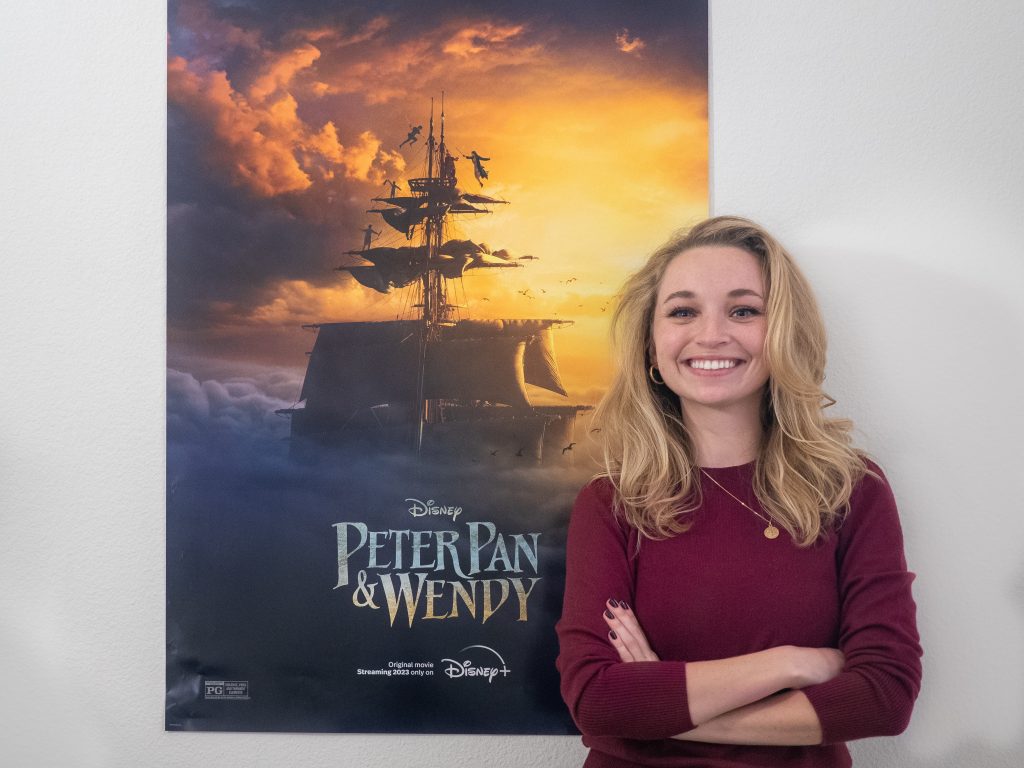
The first time Lillian Engel stepped into Elon University’s School of Communications, her attention went straight to the editing suites, not the cameras or soundstages.
“Something about seeing those editing rooms was just really intriguing,” she says. “By the time I arrived at Elon, I knew I wanted to be a cinema major. Specifically, within that, I had become interested in becoming an editor.”
That curiosity has since guided Engel through the cutting rooms of major studio projects, from “Extraction” on Netflix to “Joker: Folie à Deux” with Warner Bros. Today, she lives in Los Angeles, cutting out her place in Hollywood’s fast-moving post-production world, one frame at a time.
Growing up in Connecticut, Engel didn’t initially know that cinema and television could be a field of study. But after visiting Elon, she was drawn to the university’s approach.
“I’m a very hands-on person,” she said. “Other schools I visited talked about doing theory for the first few years. At Elon, they encouraged filmmaking from day one.”
That approach gave Engel a creative outlet and community. She joined Cinelon Productions, a student-run film organization, where she eventually served as a writing executive.
Editing is part technical and part storytelling. Knowing how to tell a story, and being able to teach that, is integral to what I do. You need a big-picture understanding so you’re not just putting shots together.
By the time she graduated in 2019, her professors knew exactly where her passion was.
“If we were doing a project, they knew I wanted to be the editor,” Engel says. “They let me tailor my time at Elon toward that focus.”
That drive carried her beyond campus. Engel interned in both New York and Los Angeles, gaining early exposure to production and post-production environments. She also studied abroad in Paris through Elon’s French program, an experience that deepened her love of global storytelling.
In 2018, she nearly missed the deadline for the American Cinema Editors’ (ACE) Student Editing Competition but managed to submit her entry just in time. A few months later, she received an email that changed her path — she was named a finalist and invited to the ACE Eddie Awards in Beverly Hills.
“It was surreal,” she says. “I was meeting people whose names I’d only ever seen in movie credits.”
The event became her first glimpse into the professional editing world and her first encounter with Elon’s vast alumni network.
“There was another Elon alumnus there, and he later referred me for what became my first job. Elon pulled through and got me my start in Hollywood,” she explained.
After graduating, Engel moved to Los Angeles without a job or apartment.
“I was couch-hopping and networking, but within weeks, two Elon connections reached out at the same time with opportunities,” she said.
One of those connections led her to her first project: Netflix’s “Extraction,” where she joined the team as an office assistant. This position served as the perfect starting point, allowing her to learn the backend of how a professional postproduction office runs.
She has since worked on high-profile projects, including “Vacation Friends” for Hulu, “Peter Pan & Wendy” for Disney+, and “Joker: Folie à Deux” for Warner Bros. As an assistant editor on “Joker: Folie à Deux,” she helped manage footage organization, sound and music coordination and communication between departments.
Now an editor for an independent feature film, she reflects on the challenges of working in an industry that thrives on connections, noting that networking mostly happens through word of mouth. Engel also remains connected to Elon’s film community, seeking to mentor students who want to enter post-production.
“When I first moved to LA, I didn’t know anyone except some other Elon connections; that network has been everything,” she said. “I always want to be a resource for students interested in editing; it’s not as shiny as directing, but it’s vital to storytelling.”
Her advice for students: Practice constantly.
“Editing is like a muscle; the more you do it, the stronger your eye and timing get. Get involved with projects, apply for competitions, and reach out to professionals. It’s all about staying curious and connecting with people.”
From the editing suites that first caught her eye to the cutting rooms of Hollywood, Engel’s path reflects the importance of curiosity and perseverance; the same values that continue to shape Elon storytellers today.
Did You Know?
- The cinema and television arts curriculum provides a broad foundation in writing and previsualization; visual aesthetics; industry best practices in areas such as audience analysis, content distribution, and equity, diversity, and inclusion; and content production.
- Through the academic program and co-curricular opportunities, students can focus on specialized areas of interest such as audio production and sound design, corporate video and branded content, documentary and narrative film, sports broadcasting and multi-camera live events, and studio- and reality-based entertainment programming.
- To promote academic depth, all students must complete a minor, double major or a semester abroad in an Elon-approved program.