

Applied Mathematics Major
Back to Majors, Minors & Academic Programs
About the Major
The applied mathematics program was built for students who have both a love of mathematics and an inquisitive nature toward the physical world. Through this major, students develop critical- and practical-thinking skills and learn techniques of mathematical analysis that can be applied to problems from different fields, including engineering, medicine and economics.
Jobs in Applied Mathematics
- Mathematician
- Actuary
- Computer programmer
- Operations research analyst
- Statistician
Past Elon Applied Mathematics Internships
- CVS
- Provident Financial Group of the Carolinas
- Naval Research Enterprise Research Program
- Elon University - Elon Center for Organizational Analytics
- Morgan Stanley
Related Majors
Graduate uses data sets to address real-world problems
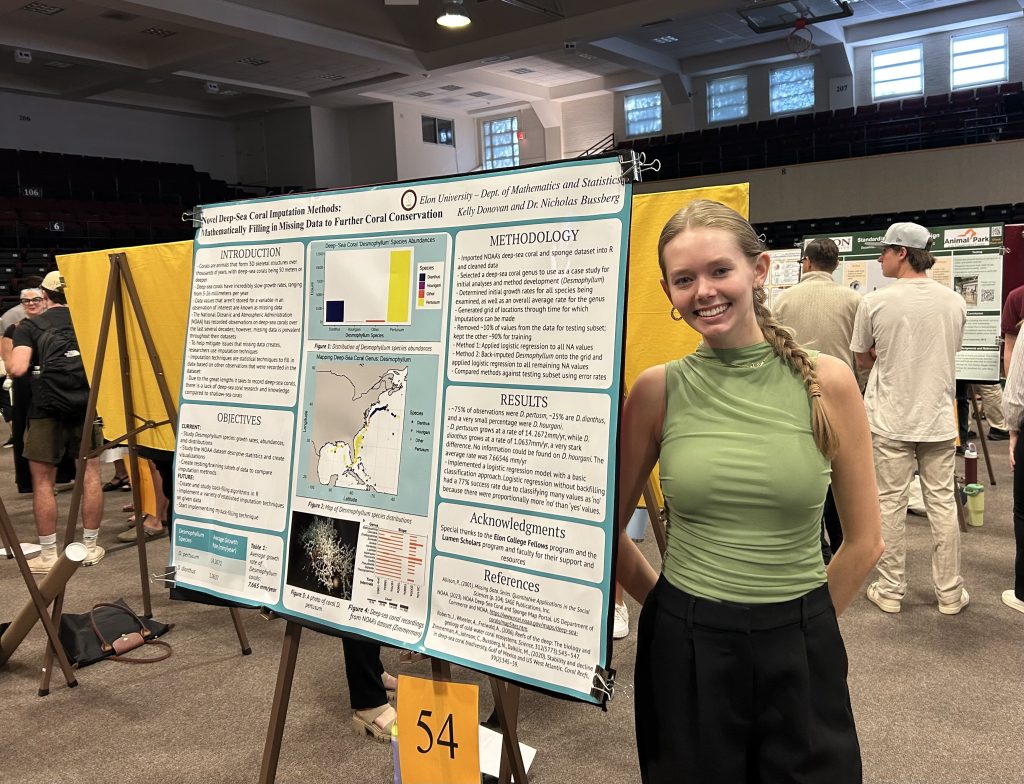
Kelly Donovan arrived at Elon University to embark on an undergraduate journey that blended rigorous quantitative analysis with active participation in the performing arts. The Cincinnati native quickly found an environment that encouraged her to explore disparate interests, performing in Elon’s mainstage theatrical productions, serving on the executive board of the Elon Muses Show Choir and studying abroad in Hawaii.
Elon has been the best decision I’ve made when it comes to my academic life … Elon has been the catalyst and support for how I’ve been able to incorporate so many interdisciplinary aspects in my life, which is crucial for my learning and enjoyment.
A central part of her academic experience was building close ties with peers and faculty in the Department of Mathematics and Statistics. As both an Elon College Fellow and a Lumen Scholar, as well as recipient of the prestigious Lumen Prize, Donovan spent two years conducting specialized research in environmental statistics. Mentored by Assistant Professor of Statistics Nicholas Bussberg, her work focused on better understanding and modeling deep-sea coral biodiversity.
Her project, titled “Novel Deep-Sea Coral Imputation Technique: Filling in Missing Data to Further Coral Conservation,” applied statistical methods to repair incomplete data sets for marine conservation efforts. Funding from her fellowships enabled her to travel to Washington, D.C., to present her findings at the Joint Mathematics Meetings, one of the largest international mathematics conferences.
In September 2024, she joined Elon faculty and students on an educational trip to the Greensboro Science Center (GSC) to meet with aquarists. Examining living corals and jellyfish allowed her to connect her dataset modeling directly to the living organisms behind the numbers.
“It’s easy to get lost in the numbers, data and code and forget what we’re doing the research for,” Donovan said. “It was nice to see both corals in person, as well as others that care about them.”
She noted that seeing the marine life firsthand offered a perspective that data alone could not replicate.
“It’s hard to picture exactly what corals are and can do, whether it’s their size, color or habitat that they create,” she said. “At the GSC, I saw how beautiful they are in real life and how they take care of organisms around them. There is no substitute for talking to someone who deals with [the organisms] on a daily basis.”
Donovan graduated from Elon University in May 2026 with double majors in statistics and applied mathematics and double minors in geographic information systems and geography. Continuing her trajectory in higher education, she transitioned to Wake Forest University to pursue her master’s degree in statistics as a Dean’s Scholar.
Did You Know?
- Applied mathematics majors learn quantitative skills that will help them in almost any career involving problem-solving. The degree requires less mathematical theory than the pure mathematics degree but gives students the opportunity to have a stronger emphasis on an outside area of study such as physics, chemistry, biology or economics.
- As with most mathematical disciplines, applied mathematics is linear in nature. Material covered early in the major will be used, expanded upon and sometimes verified in later courses. Students are required to do either a research project or an internship focused on an area tied to an allied discipline so that the tools and methods are used in a natural context.
- Applied mathematics majors are required to take courses that are focused on mathematical tools as well as a modeling course that emphasizes the need for practical thinking and careful understanding of the systems being described mathematically. They also are expected to become familiar with some computer programming and statistical techniques.